Introduction
The internet is full of people telling us how to become better versions of ourselves. Wake up at 5 a.m. Buy the planner. Go to the gym. Become more productive. Become more attractive. Become richer. Become “that girl.”
Yet somewhere between the morning routines and perfectly curated lifestyles, self-improvement can start feeling exhausting. Instead of helping us become happier, it can make us feel as though we are never enough.
And then there is Tam Kaur.
Tam Kaur has built something different: a personal brand around self-love, confidence, personal growth and becoming the person you actually want to be. Her content speaks particularly strongly to young women because it doesn’t simply sell an aesthetic. It sells a mindset. Her broader mission is to help women invest in themselves, build confidence and close the gap between their current and desired selves.
So what exactly did she get right?

She Built A Brand, Not Just A Following
One of the biggest mistakes creators make is confusing an audience with a brand.
You can have thousands of followers and still have no clear identity. Tam Kaur, however, created a recognisable world around herself.
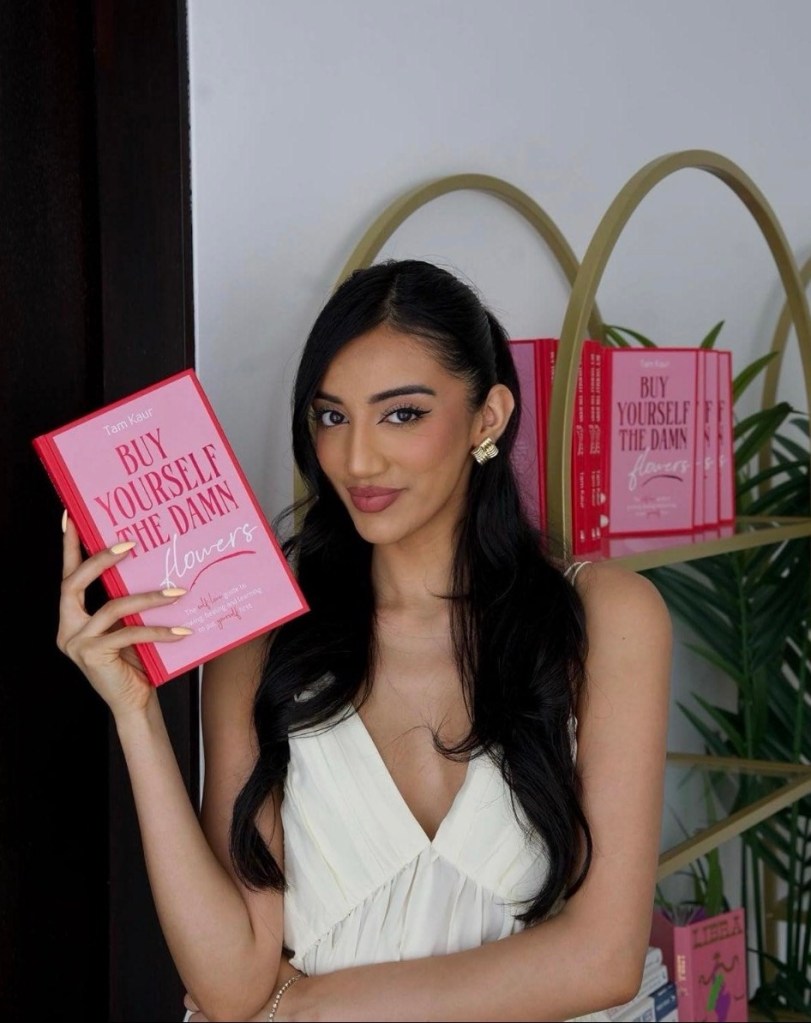
Her message is remarkably consistent: self-love, confidence, boundaries, personal development and becoming your own priority. Her podcast, Self Obsessed, extends exactly the same philosophy, while her book Buy Yourself the Damn Flowers turns it into a physical product.
That consistency matters.
When someone sees a Tam Kaur video, they generally know what emotional territory they are entering. They are not simply watching “a girl talking to a camera.” They are entering a philosophy.
That is branding.

She Turned Personal Experience Into Useful Content
Tam’s content is personal, but it isn’t purely autobiographical.
She has spoken about confidence, loneliness, relationships, boundaries, self-worth and the process of changing herself. Importantly, she has explained that many of her content ideas come from her own experiences and lessons.
That creates an incredibly powerful formula:
Experience → lesson → content → community.
Instead of pretending to have all the answers from the beginning, she built authority by sharing what she was learning.
This is particularly effective in the self-development space because audiences don’t necessarily want a distant expert lecturing them. They want someone who feels like they are a few steps ahead.
Tam understood that.

She Made Self-Improvement Emotional
There is a reason phrases such as “buy yourself the damn flowers” are more memorable than “practice self-care.”
The first is emotional.
Tam’s language is direct, feminine and occasionally provocative. Her brand doesn’t present self-love as a vague concept. It turns it into behaviours: taking yourself on dates, setting boundaries, choosing yourself and learning to enjoy your own company.
Her podcast describes itself as a guide to self-love, self-confidence, self-worth and self-growth, with episodes designed to provide actionable advice rather than simply inspiration.
That distinction is important.
People don’t just want to feel motivated for ten minutes. They want to know what to do next.

She Understood The Power Of A Niche Audience
Tam didn’t try to speak to everyone.
Her content is heavily centred around young women navigating confidence, relationships, identity and personal growth. That specificity is a competitive advantage.
The internet rewards creators who make people feel understood.
When a viewer thinks, “She is literally talking about me,” they don’t just watch the video. They return. They subscribe. They share it with friends. They buy the book. They listen to the podcast.
A niche audience can therefore become a remarkably powerful community.
Today, Tam’s official site describes a community of more than three million people across platforms, alongside more than 50 million social views and four million podcast downloads.
The numbers are impressive. But the more interesting achievement is what sits underneath them: recognition.

She Created A Brand People Can Identify With
She didn’t stop at YouTube.
Perhaps the smartest part of Tam Kaur’s strategy is that she didn’t allow her career to remain dependent on one platform.
Her journey expanded from YouTube into podcasting, publishing, speaking and entrepreneurship. Her official site now positions her as an author, entrepreneur, speaker and podcaster, while her Self Obsessed identity has developed into a broader wellness brand.
This is where creator becomes business.
A YouTube video disappears down a feed. A book can sit on someone’s bookshelf for years. A podcast creates recurring attention. A brand can sell products. Speaking creates authority.
Each piece strengthens the others.
That’s a lesson every aspiring creator should pay attention to.
She Treated Content Creation Seriously
Tam’s growth wasn’t simply a case of “going viral.”
According to her own account, she returned to YouTube while studying and deliberately treated the channel like a part-time job rather than a casual hobby. Her channel subsequently went from under 1,000 subscribers to more than one million in roughly 15 months, according to her official biography.
That mentality is crucial.
Creators often focus on creativity while forgetting the word creator is also a job description.
There is research. There is strategy. There is consistency. There is editing. There are thumbnails, titles, positioning, audience psychology and business development.
Talent may get you started.
Systems keep you going.

The Real Lesson
What makes Tam Kaur interesting isn’t simply that she became successful.
It’s that she understood something fundamental about the creator economy: people don’t only follow information. They follow transformation.
Her audience isn’t just being given advice about confidence. They are being invited to imagine who they could become.
That is a much stronger proposition.
And perhaps that’s why Tam Kaur got it right.
She didn’t build her brand around being perfect. She built it around becoming better.
She didn’t simply tell women to love themselves. She created an entire identity around choosing themselves.
And she didn’t leave her message trapped inside a social-media feed. She turned that message into a podcast, a book, a community and an expanding business.
In an internet increasingly saturated with influencers, that distinction matters.
Because the creators who last won’t necessarily be the ones who post the prettiest pictures.
They will be the ones who stand for something.
Tam Kaur figured that out.



Leave a Reply