Introduction
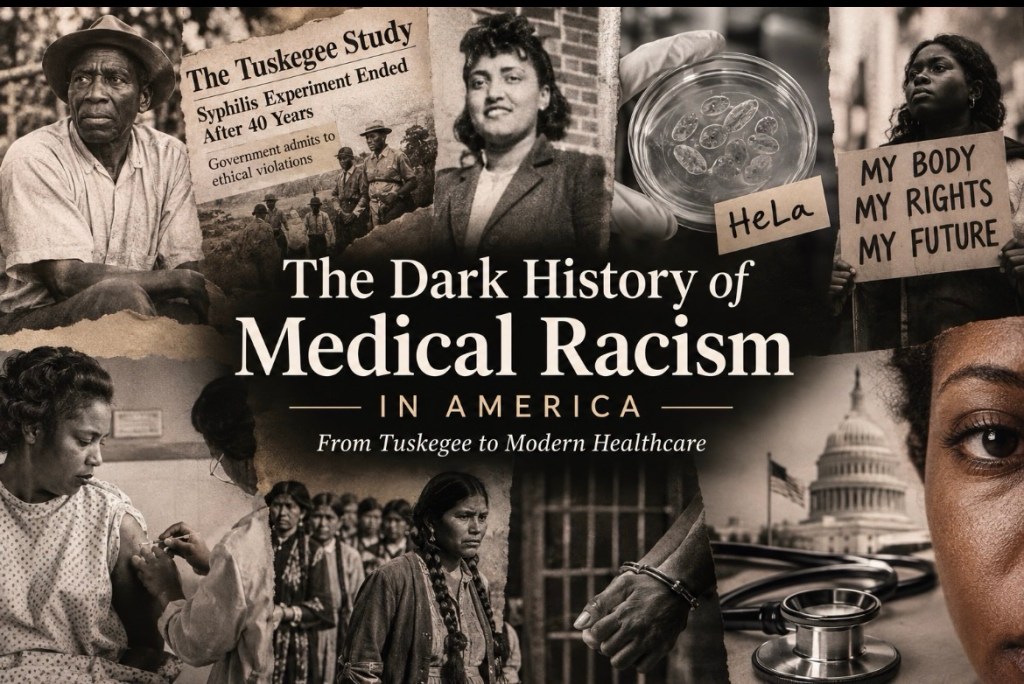
Medical science is often associated with progress, innovation and the preservation of human life. Yet, throughout American history, medicine has also been used as a tool of exploitation, particularly against Black Americans, Indigenous communities, prisoners and other vulnerable populations. From unethical experiments on enslaved women to the infamous Tuskegee syphilis study, these cases reveal a disturbing reality: scientific advancement has sometimes come at the expense of human dignity.
Although many of these abuses occurred decades ago, their consequences continue to influence public trust in healthcare, medical research and the American healthcare system today.
The Tuskegee Syphilis Study: Four Decades of Deception
One of the most notorious examples of medical racism was the Tuskegee syphilis study, conducted by the United States Public Health Service in Alabama between 1932 and 1972.
Researchers enrolled 600 Black men, including 399 who had syphilis and 201 who did not. The stated purpose was to observe the disease’s progression in the human body. However, the participants were not properly informed about the study, and many were misled into believing they were receiving medical treatment for a condition described as “bad blood.”
The greatest ethical violation occurred when penicillin became an established treatment for syphilis during the 1940s. Researchers failed to ensure that infected participants received the treatment, allowing the study to continue despite the availability of an effective therapy.
The experiment was exposed to the public in 1972, provoking widespread outrage. The study was subsequently terminated, and a class-action lawsuit resulted in a settlement for participants and their families. In 1997, President Bill Clinton formally apologized on behalf of the United States government.
The scandal became a defining example of unethical human experimentation and helped accelerate reforms in research ethics.
Henrietta Lacks: The Woman Behind a Medical Revolution
Another important case began in 1951 at Johns Hopkins Hospital in Baltimore. Henrietta Lacks, a Black woman receiving treatment for cervical cancer, had cells taken from her tumor without her knowledge or consent.
These cells, later known as HeLa cells, proved extraordinarily useful to researchers because they could reproduce continuously under laboratory conditions. They contributed to major advances in biomedical research, including the development of polio vaccines, cancer research and genetic studies.
However, while the scientific community benefited enormously from the cells, Lacks and her family were not adequately informed about their use for many years. Her relatives later raised concerns about privacy, consent and the commercial benefits derived from her biological material.
The case became a landmark discussion about the rights of patients, the ownership of biological samples and the ethical responsibilities of researchers. In 2013, the National Institutes of Health reached an agreement with the Lacks family concerning access to HeLa genomic data.
Henrietta Lacks’s legacy illustrates a fundamental ethical question: should scientific progress come at the expense of an individual’s right to make informed decisions about their own body?
Forced Sterilizations and the Violation of Reproductive Rights
Medical racism also extended into reproductive healthcare. Throughout the twentieth century, eugenics—the belief that society could be improved by controlling reproduction—contributed to discriminatory sterilization policies across the United States.
Black women, Indigenous women, poor women and women with disabilities were particularly vulnerable to coercive practices.
In 1976, the U.S. Government Accountability Office investigated sterilization practices within four regional areas of the Indian Health Service. It identified 3,406 sterilizations of Native American women between 1973 and 1976 and found serious failures to comply with federal sterilization regulations.
Concerns included inadequate consent procedures and the sterilization of women who did not meet the applicable age requirements. These findings highlighted the vulnerability of Indigenous patients within a healthcare system that was supposed to protect them.
A related history is captured by the term “Mississippi appendectomy,” which refers to sterilizations, sometimes performed without meaningful consent, on Black women in the American South. These cases demonstrate how medical authority could be used to restrict reproductive freedom rather than safeguard it.
Holmesburg Prison: Experimentation Behind Bars
Between the 1950s and 1970s, researchers conducted numerous experiments on incarcerated people at Holmesburg Prison in Philadelphia. Dermatologist Albert Kligman was among the researchers involved.
Many participants were Black men, and experiments included exposure to chemicals, drugs and other substances. Although some prisoners agreed to participate in exchange for financial compensation, the prison environment raised serious questions about whether consent could be genuinely voluntary.
People in custody have limited freedom and may feel pressured to accept risks in exchange for money or other benefits. This creates a significant ethical problem when researchers recruit them for potentially harmful experiments.
The Holmesburg case illustrates why modern research ethics must consider not only whether someone signs a consent form, but also whether that person is genuinely free to refuse participation.
J. Marion Sims and the Origins of Modern Gynecology
The history of medical racism stretches further back than the twentieth century. In the 1840s and 1850s, physician J. Marion Sims performed experimental gynecological operations on enslaved Black women, including Anarcha, Betsy and Lucy.
Because these women were enslaved, they could not provide free and equal consent. Some procedures were repeated, and historical accounts describe operations performed without anesthesia.
Sims later became celebrated for his contributions to gynecological surgery. However, his reputation has increasingly been reconsidered in light of the suffering endured by the women whose bodies were used in his experiments.
Their experiences raise an enduring question about medical history: how should society recognize scientific achievements when those achievements were developed through exploitation and unequal treatment?
The Legacy of Medical Racism Today
The end of notorious experiments did not eliminate racial inequalities in American healthcare.
Research has documented persistent disparities in pain assessment and treatment, including the influence of false beliefs about biological differences between Black and white patients. Black women also experience substantially higher pregnancy-related mortality than white women in the United States.
These disparities cannot all be attributed to deliberate racism or unethical experimentation. They involve multiple factors, including healthcare access, socioeconomic conditions, differences in treatment quality and the effects of structural discrimination.
Nevertheless, historical abuses help explain why some communities remain distrustful of medical institutions. Trust is built through transparency, respectful treatment, accountability and the assurance that patients’ rights will be protected.
Conclusion
From Tuskegee to Henrietta Lacks, from forced sterilizations to prison experiments, America’s medical history contains examples of scientific ambition overriding basic human rights.
These cases contributed to reforms in informed consent, research oversight and the protection of vulnerable participants. The National Research Act of 1974 and the Belmont Report of 1979 helped establish principles that continue to guide research involving human subjects.
Yet ethical rules alone cannot guarantee fairness. Medical institutions must also confront historical wrongdoing, address present-day disparities and ensure that every patient receives dignity and respect.
The ultimate lesson is clear: medical progress should never be measured solely by scientific discovery. It must also be measured by how humanity treats the people whose lives make that progress possible.


Leave a Reply