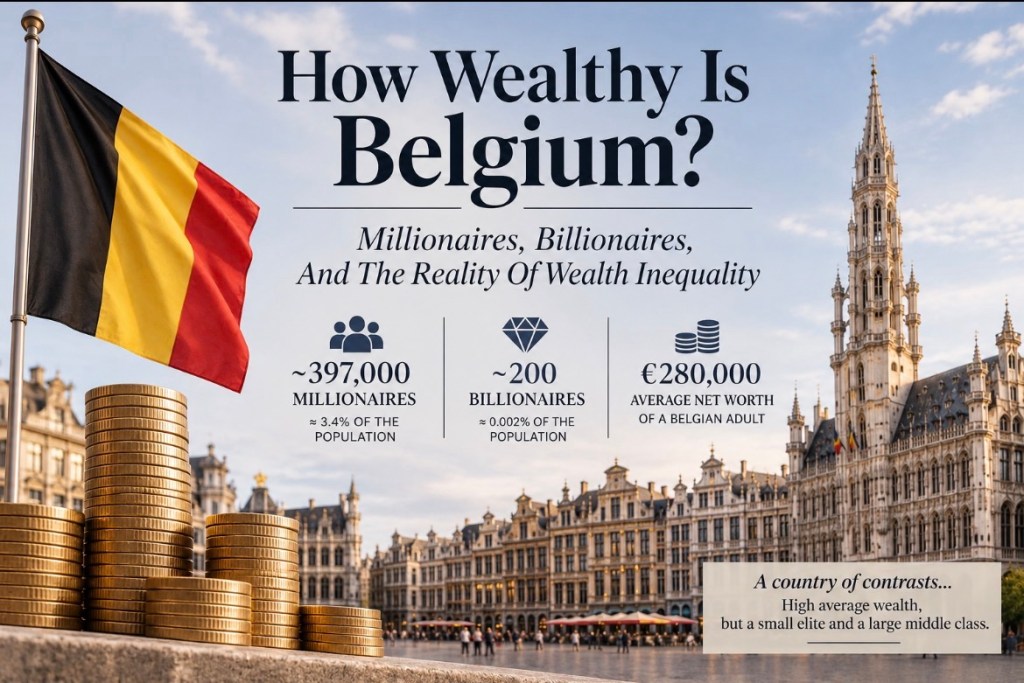
Belgium is often considered one of Europe’s wealthier countries. With a strong economy, an established welfare system and widespread homeownership, many Belgian households have accumulated significant assets over time. But how wealthy is Belgium really? How many Belgians are millionaires, how many are billionaires, and how unequally is wealth distributed?
The answers reveal a fascinating picture of prosperity, financial security and economic inequality.
How Much Wealth Does Belgium Have?
According to figures from the National Bank of Belgium for the first quarter of 2026, Belgian households collectively held approximately €3.145 trillion in net wealth. Net wealth represents the value of assets minus outstanding debts.
The average net wealth per household was approximately €610,000. However, the median household held around €287,000.
Why is the difference so significant?
The average is influenced by the country’s wealthiest households, whose fortunes can be worth millions or even billions of euros. The median, by contrast, represents the midpoint: half of households have less wealth and half have more.
Consequently, the median often provides a more realistic picture of the financial position of a typical Belgian household.
How Many Millionaires Live in Belgium?
Belgium has a substantial millionaire population. According to Capgemini’s 2025 figures, approximately 146,400 people in Belgium had at least $1 million in investable assets.
That represents roughly 1.2% to 1.3% of the population, or approximately one person in every 80.
However, this statistic requires an important distinction. Capgemini’s definition of investable wealth does not include every asset someone owns. A primary residence and certain other personal assets are excluded. Therefore, the number of Belgians with a total net worth exceeding €1 million may differ considerably.
Among these dollar millionaires, the distribution is particularly revealing:
● Approximately 135,412 people had between $1 million and $5 million.
● Around 10,397 had between $5 million and $30 million.
● Approximately 618 had more than $30 million in investable assets.
These figures demonstrate that being a millionaire does not necessarily mean belonging to the ultra-rich. Most millionaires fall into the lowest wealth bracket, while only a tiny fraction possess fortunes exceeding $30 million.
Belgium’s Billionaires: An Extremely Small Elite
At the other end of the wealth spectrum are billionaires.
Forbes Belgium reported 18 Belgian nationals on its global billionaire list in 2026, following 17 in 2025. Depending on the ranking and date, these figures may change as asset valuations fluctuate.
Compared with Belgium’s population of approximately 11.9 million, 18 billionaires represent roughly 0.00015% of the population. In other words, there is approximately one billionaire for every 660,000 inhabitants.
Their wealth is often generated through business ownership, industrial holdings, investments and inherited fortunes. Unlike a salary, which provides income over time, ownership of a successful company can create enormous wealth as the business grows in value.
This distinction helps explain why entrepreneurship and equity ownership feature so prominently among the world’s wealthiest individuals.
Who Owns Belgium’s Wealth?
Perhaps the most revealing statistic concerns wealth inequality.
According to the National Bank of Belgium’s household wealth figures for the first quarter of 2026, the wealthiest 10% of households owned approximately 54.4% of total household net wealth.
Meanwhile, the poorest 50% owned just 7.7%.
This means that the richest tenth of households collectively owned more than seven times the wealth of the bottom half.
These figures concern accumulated wealth, not annual income. A household may earn a moderate salary while owning a valuable property purchased decades ago. Conversely, a household with a high income may have limited net wealth if it carries substantial debts or spends most of its earnings.
Wealth inequality therefore reflects more than differences in salaries. It also reflects property prices, inheritances, financial investments, business ownership and the ability to save over many years.
How Does Belgium Compare Internationally?
Belgium performs relatively well in international household wealth comparisons.
The UBS Global Wealth Report 2026 estimated average wealth per adult in Belgium at approximately $407,920, with median wealth per adult around $277,166.
These figures place Belgium among the wealthier countries internationally, although rankings depend on exchange rates, asset prices and measurement methods.
Belgium’s relatively high median wealth is particularly interesting. It suggests that wealth is not confined entirely to a small elite, even though the distribution remains unequal.
Homeownership plays an important role in this picture. Property can represent a substantial share of a household’s assets, especially for people who bought their homes years ago and have paid down their mortgages.
However, high property values do not automatically translate into readily available cash. Someone can be wealthy on paper while having relatively little disposable income.
What Does It Mean to Be Rich in Belgium?
There is no single definition of being rich. Nevertheless, several benchmarks provide useful context.
A household with approximately €287,000 in net wealth sits around the national median, while €610,000 corresponds to the average. A household needs roughly €1.16 million in net wealth to enter the top 10%, according to the National Bank’s reported threshold.
A net worth of €1 million therefore represents considerable wealth, but it does not automatically place someone among Belgium’s richest households.
At €5 million or €10 million, financial independence and investment opportunities may become much more substantial, depending on spending and liabilities. Fortunes above €30 million occupy a much narrower segment of the wealth distribution.
These are illustrative benchmarks, not official percentile thresholds for every category.
Conclusion: A Wealthy Country with Unequal Wealth
Belgium is a wealthy country by international standards, with trillions of euros in household net assets and approximately 146,400 dollar millionaires. Yet the distribution of that wealth is far from equal.
The richest 10% of households own more than half of the country’s household net wealth, while the bottom half owns less than one-tenth. At the very top, billionaires represent an exceptionally small fraction of the population.
Understanding these numbers requires looking beyond salaries and headline fortunes. Property ownership, investment returns, inheritance, debt and business equity all influence where households stand financially.
Ultimately, the most useful question is not simply how many millionaires Belgium has. It is how wealth is accumulated, how broadly it is distributed and what opportunities people have to build lasting financial security.
Sources: National Bank of Belgium, Capgemini World Wealth Report 2025, Forbes Belgium and UBS Global Wealth Report 2026. Figures use different definitions of wealth and should not be compared without considering their methodologies.


Leave a Reply