From cobalt in the Democratic Republic of the Congo to rare earths in China, the metals beneath our feet are reshaping economies, international relations and the future of global power.
The New Geography of Power
Power is no longer measured only in military strength, population or economic output. Increasingly, it also depends on something buried underground: metals.
Copper, lithium, cobalt, nickel and rare earth elements are essential to electric vehicles, smartphones, wind turbines, electricity grids and advanced military technologies. As countries compete to electrify their economies and strengthen their technological independence, access to these resources has become a strategic priority. The International Energy Agency (IEA) identifies concentrated supply chains and export restrictions as growing risks to global economic security.
But geological wealth is distributed unevenly. Some countries possess enormous mineral deposits, while others depend on imports to maintain their industries. This imbalance creates opportunities for economic growth, but also vulnerabilities, rivalries and political tensions.
Who Controls the World’s Most Important Metals?
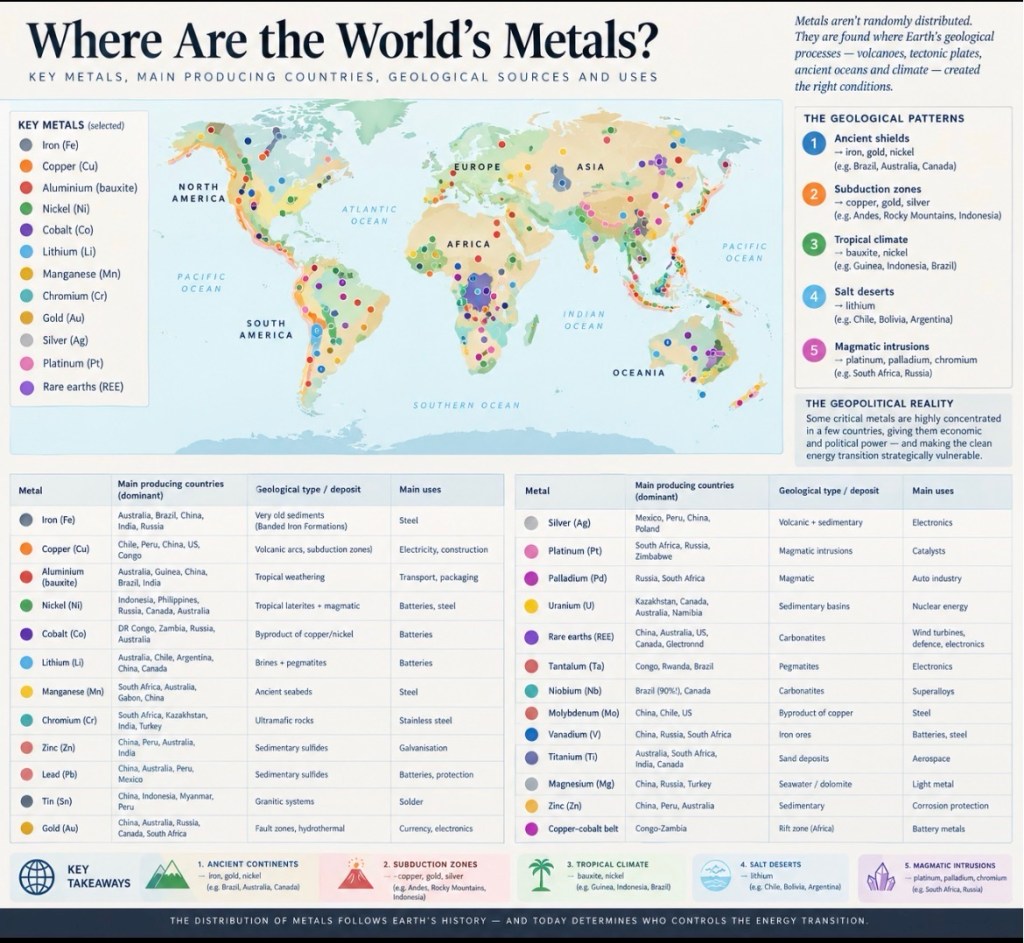
Different countries dominate different stages of the mineral supply chain. Crucially, extracting a metal is not the same as refining it into a usable industrial material.
● Cobalt — Democratic Republic of the Congo The DRC accounted for approximately 76% of global mined cobalt production in 2024. Cobalt is used in many rechargeable batteries, although some battery chemistries reduce or eliminate its use.
● Lithium — Australia, Chile and China: Australia is a major source of mined lithium, while Chile extracts lithium from salt brines. Argentina is an increasingly important producer. Bolivia also holds substantial lithium resources, but resources underground do not automatically translate into large-scale commercial production.
● Nickel — Indonesia: Indonesia has become a dominant force in nickel mining and processing, supplying a critical ingredient for stainless steel and certain electric-vehicle batteries.
● Rare earth elements — China: China dominates rare-earth processing and the production of many rare-earth-based materials used in permanent magnets, electronics and defence equipment.
● Copper — Chile and Peru: These South American producers are central to global copper supply. Copper is indispensable for electrical wiring, renewable energy infrastructure and expanding electricity grids.
● Platinum — South Africa: South Africa holds a major position in platinum production, supplying a metal used in catalytic converters, chemical processes and other industrial applications.
These examples reveal an important distinction: the country with the minerals is not necessarily the country with the greatest control over the finished product. China, for instance, has developed extensive refining and manufacturing capabilities, allowing it to capture value beyond extraction.
Supply and Demand: When Geology Moves Markets
Like other commodities, metals respond to supply and demand. When demand rises faster than production, prices tend to increase. When supply expands faster than consumption, prices can fall.
The energy transition is changing these markets. Electric vehicles, battery storage and electricity networks require substantial quantities of certain minerals. In its 2025 outlook, the IEA projected that lithium demand could grow fivefold by 2040 under its stated-policies scenario, while copper demand could increase by around 30%. These are projections, not guaranteed outcomes.
Mining cannot always respond quickly. Developing a mine can require years of exploration, investment, permitting and construction. Environmental restrictions, infrastructure shortages and political instability can delay production further.
Consequently, a disruption at one major mine or processing facility can affect manufacturers thousands of kilometres away. Higher mineral prices can raise the cost of batteries, vehicles, electronics and renewable energy projects. Lower prices, meanwhile, may benefit manufacturers and consumers but hurt mining companies and resource-dependent governments.
Minerals, Conflicts and Political Tensions
Mineral wealth can strengthen a country’s negotiating position. A government controlling a major share of global supply may use export restrictions, taxes or investment conditions to increase domestic benefits or gain strategic leverage.
The DRC illustrates this dynamic. Its importance in cobalt mining gives its government influence over a material essential to many battery supply chains. In 2025 and 2026, changes to its cobalt export policy demonstrated how decisions by a major producer can affect international supply and prices.
China’s position in rare-earth processing offers another example. Restrictions on strategically important materials can expose the dependence of foreign manufacturers on a concentrated supply chain.
Mineral competition can also intersect with armed conflict. In parts of Central Africa, competition over valuable resources has interacted with armed groups, illicit trading networks, weak institutions and local grievances. However, minerals are rarely the sole cause of a conflict. Governance, historical tensions and political conditions also matter.
The central problem is that the economic value of a resource can attract investment while simultaneously intensifying competition over who controls its extraction and profits.
The Resource Curse: Wealth Underground, Poverty Above It?
Possessing valuable minerals does not guarantee national prosperity.
Mining can generate export revenues, employment, infrastructure investment and government tax income. Yet countries can struggle to convert these benefits into broad-based development when institutions are weak, revenues are poorly managed or profits leave the country without sufficient local value creation.
A country exporting raw ore may capture less economic value than one refining it, manufacturing components and developing the technologies that use them.
This is why governments increasingly seek domestic processing, technology transfers and partnerships that create skilled jobs. The challenge is to secure investment while protecting workers, communities and the environment.
The Future: Cooperation or Competition?
Governments are responding by diversifying suppliers, investing in domestic mines, expanding recycling and developing alternative materials. The European Union, United States and other industrial economies are seeking to reduce strategic dependencies.
Nevertheless, diversification takes time. The IEA reported that the average market share of the three largest refining countries for key energy minerals rose from around 82% in 2020 to 86% in 2024.
Recycling, technological innovation and international cooperation could reduce some vulnerabilities, but they will not eliminate the need for mining.
Ultimately, the metals that power modern life are more than commodities. They are instruments of economic influence, sources of industrial opportunity and potential flashpoints in international relations.
The defining question of the coming decades is not simply who owns the world’s metals, but who controls their processing, trade and transformation into economic value. In a world increasingly dependent on electrification and advanced technology, that distinction could help determine the balance of global power.


Leave a Reply