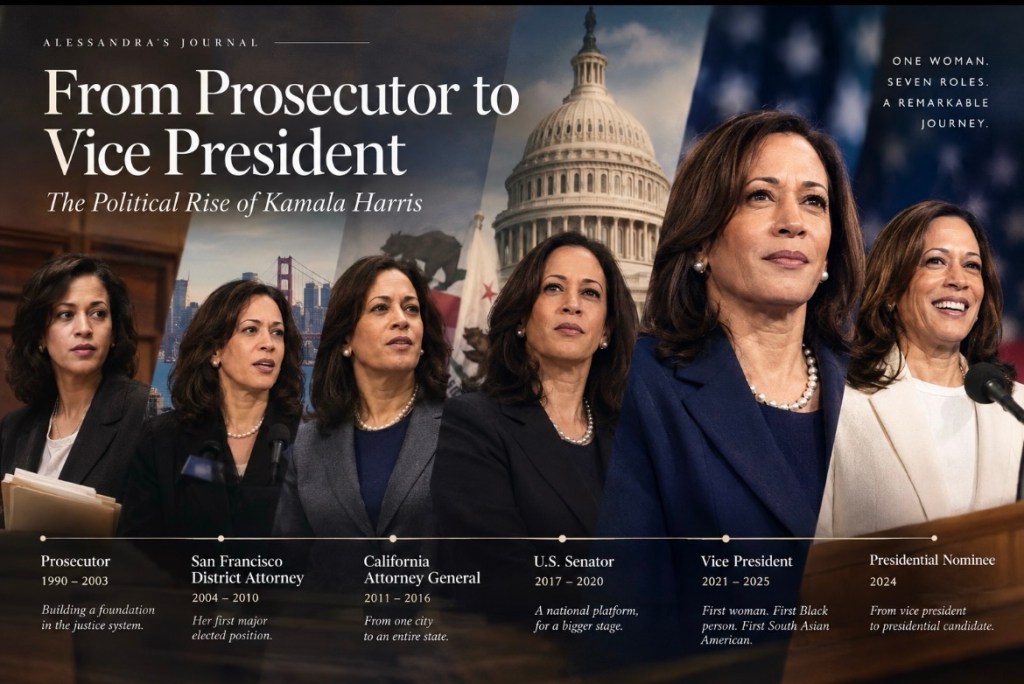
Kamala Harris’s political career is a story of gradual accumulation of power. Long before she became vice president of the United States, Harris built her reputation in courtrooms, prosecutors’ offices and California politics. Her trajectory was neither the traditional route of a lifelong legislator nor the path of a political dynasty. Instead, she moved through the American political system one increasingly influential position at a time: prosecutor, district attorney, attorney general, senator, vice president and, eventually, presidential nominee.
Her rise illustrates how a career in American politics can expand from local institutions to the national stage — and how professional experience can become the foundation for political ambition.
The Prosecutor
Harris began her professional career in law rather than electoral politics. After graduating from the University of California, Hastings College of the Law, she became a deputy district attorney in Alameda County, California, in 1990.
For more than a decade, she worked within California’s criminal-justice system, developing the prosecutorial experience that would remain central to her public identity.
In 2003, she challenged the incumbent San Francisco district attorney, won the election and took office in 2004. At 39, Harris had moved from working within the system to leading one of California’s most prominent prosecutorial offices.
From San Francisco to Sacramento
In 2010, Harris was elected California’s attorney general, becoming the first woman, first African American and first South Asian American to hold the position. She took office in 2011.
The role gave her responsibility over a statewide law-enforcement and legal institution while providing a much larger political platform. During her tenure, she addressed issues including financial institutions, consumer protection, criminal justice and immigration. Her office also participated in major settlements following the financial crisis, including a multibillion-dollar mortgage settlement.
The Senate: Entering National Politics
In 2016, Harris won election to the United States Senate, succeeding Barbara Boxer as California’s junior senator. She entered the Senate in January 2017.
The move shifted her from California politics to the federal government, where she participated in national legislation and high-profile congressional investigations. Her questioning of government officials during Senate hearings, particularly those involving the Trump administration, attracted national attention.
The Presidential Campaign
In January 2019, Harris announced her campaign for president. She emphasized her experience in law enforcement and government while focusing on healthcare, economic opportunity, criminal justice and women’s rights.
She suspended her campaign in December 2019, before the Democratic primary concluded. Although unsuccessful, the campaign expanded her national visibility and introduced her to a much larger electorate.
Vice President of the United States
In August 2020, Joe Biden selected Harris as his running mate. The Democratic ticket won the November election, and on January 20, 2021, Harris was sworn in as the 49th vice president of the United States.
Her inauguration marked several historic milestones: she became the first woman, first Black American and first South Asian American to serve as vice president. She also became president of the Senate, combining a constitutional role in the legislative branch with executive responsibilities.
Her portfolio included voting rights, immigration, reproductive rights, infrastructure, technology and international diplomacy, making her one of the Biden administration’s most visible representatives.
From Vice President to Presidential Nominee
The next major stage of Harris’s career came in 2024. After Joe Biden ended his reelection campaign in July, Harris became the Democratic Party’s presidential nominee.
She launched her campaign only months before the November election, moving rapidly from vice president to presidential candidate. She ultimately lost to Donald Trump, and her vice-presidential term ended in January 2025.
A Career Built in Layers
Harris’s career can be summarized as:
Prosecutor → District Attorney → Attorney General → U.S. Senator → Vice President → Presidential Nominee
Each step expanded the geographical and institutional scale of her authority. She began in a county prosecutor’s office, moved to San Francisco, then to California’s state government, Washington and the vice presidency before reaching the national presidential stage.
Her trajectory is ultimately one of institutional progression: gaining experience at one level of government, moving to the next and transforming professional expertise into political opportunity. From a California courtroom to the White House complex, Kamala Harris’s career illustrates how local experience, statewide office and national ambition can combine to produce an extraordinary political rise.


Leave a Reply