We often talk about “the rich,” “the middle class,” and “the poor” as though society were divided into three neat boxes. It isn’t. Wealth is a spectrum, and social class is far more complicated than a number on a payslip.
Two people can earn the same salary while living completely different lives. One may have inherited a house, investments and a family business. The other may be renting, carrying student debt and supporting a family. One has wealth behind their income; the other has only income.
That is why understanding social class requires looking at both annual income and net worth — and, beyond those, education, occupation, connections, inheritance and power.
There is no universally accepted seven-tier classification, but the following model provides a useful way of visualising the spectrum, from the lower-lower class to the upper-upper class. The financial ranges are illustrative, broadly Western and particularly useful as a US-style reference rather than an official global standard.
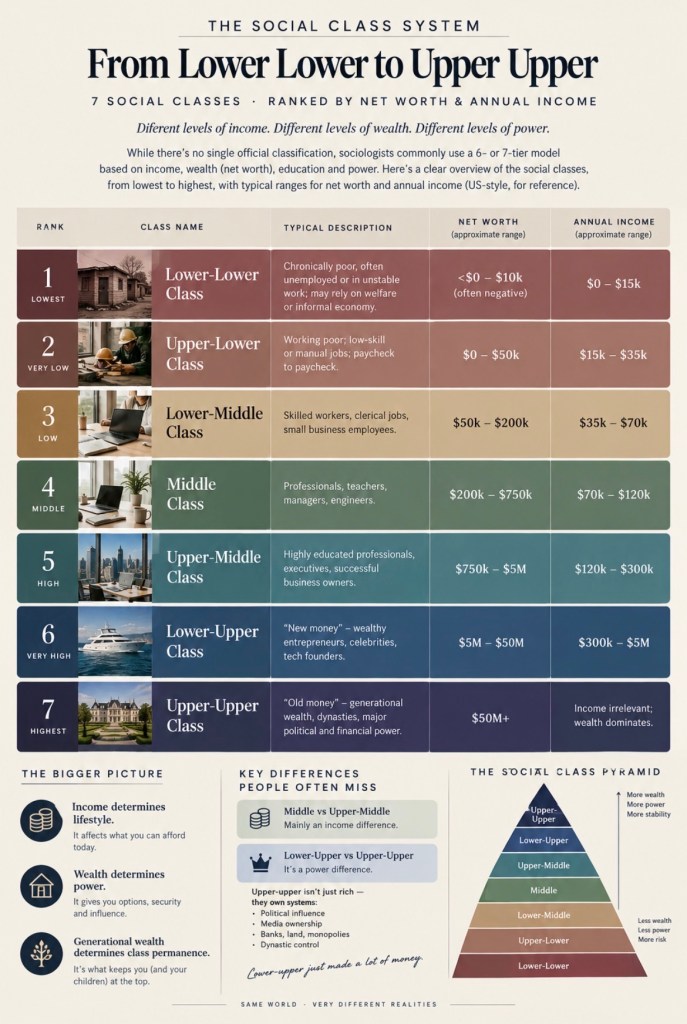
Lower-Lower Class
At the bottom of the hierarchy is the lower-lower class: people experiencing persistent poverty and severe financial insecurity.
Annual income may be extremely low or nonexistent, while net worth can be close to zero or negative because of debt. Employment may be unstable, part-time or absent altogether.
For this group, money is primarily about survival. An unexpected medical bill, rent increase or broken appliance can become a genuine financial crisis.
The defining characteristic isn’t simply having little income. It is having very little financial security or economic control.
Upper-Lower Class
Above them is the upper-lower class, sometimes associated with the working poor.
These individuals may have steady employment but relatively low wages. They might work in retail, hospitality, transportation, construction, cleaning, manufacturing or other lower-paid occupations.
They earn enough to participate in the economy but often lack substantial savings or investments.
The defining experience is frequently living from paycheck to paycheck.
Employment provides income, but not necessarily wealth.
Lower-Middle Class
The lower-middle class represents a transition toward greater stability.
Skilled tradespeople, administrative employees, technicians and lower-level professionals can fall into this category. Household incomes might be considerably higher than those of the working poor, while net worth gradually accumulates through savings, pensions and home ownership.
This is often the first level at which people can begin building meaningful financial security.
Yet the distinction between income and wealth becomes increasingly important. A household earning $70,000 with substantial home equity may ultimately be wealthier than one earning $100,000 while carrying significant debt.
Middle Class
The traditional middle class occupies the centre of the spectrum.
Teachers, engineers, managers, established professionals and many small-business owners can fall into this category. Income provides a comfortable lifestyle, while savings, pensions, property and investments provide a financial cushion.
The middle class is often associated with the classic markers of economic stability: owning or comfortably renting a home, maintaining savings, financing education and taking occasional holidays.
But even here, lifestyle can conceal enormous differences in wealth.
Upper-Middle Class
The upper-middle class is where income and accumulated wealth begin to diverge dramatically from the broader population.
Highly educated professionals, senior executives, doctors, lawyers, successful entrepreneurs and senior managers may earn several hundred thousand dollars per year.
They often possess significant investment portfolios, valuable property and retirement assets.
The important distinction is that their wealth is usually substantial but still connected to professional income.
Stop working, and the flow of new money may slow considerably.
Lower-Upper Class
Now we enter what is commonly perceived as the genuinely wealthy.
The lower-upper class includes successful entrepreneurs, major business owners, investors, celebrities, highly compensated executives and individuals who have experienced a major liquidity event.
Net worth might range from several million dollars to tens of millions.
At this level, money begins to behave differently.
A person no longer needs to rely exclusively on their salary. Investments, businesses, property and capital can generate additional income.
This is the world of “new money.”
The defining transition is from working primarily for money to increasingly having money work for you.
Upper-Upper Class
At the very top sits the upper-upper class.
Here, wealth can reach tens or hundreds of millions — and sometimes billions.
But wealth alone does not fully explain this class.
The upper-upper class is distinguished by ownership, inheritance, influence and institutional power.
These can be families whose fortunes have existed for generations, founders who built enormous companies, major investors, industrial dynasties or individuals controlling vast collections of assets.
Their annual income can become almost irrelevant compared with the value of what they own.
Someone earning $5 million annually is extraordinarily wealthy. Someone owning $5 billion is operating on an entirely different economic scale.
Income Is Not Wealth
This is perhaps the most important lesson of the entire hierarchy.
Income determines what you can afford today. Wealth determines how secure you are tomorrow.
A high-income professional can have an extraordinary lifestyle while possessing surprisingly little net worth. Conversely, someone with a modest annual income may own valuable property, businesses and investments accumulated over decades.
And then there is inheritance.
Generational wealth can provide access to elite education, property, social networks, investment opportunities and business capital before someone earns their first serious salary.
That creates an advantage that is difficult to measure on an income chart.
The Real Hierarchy
Ultimately, social class isn’t simply a ladder of salaries.
It is a hierarchy of economic freedom.
At the bottom, people exchange time for survival. In the middle, people exchange time for comfort and security. Higher up, people increasingly own assets that generate income without requiring their constant labour.
And at the very top, wealth can become institutional: companies, property portfolios, financial assets, foundations, political connections and family fortunes.
That is why the distance between the middle class and the upper-upper class cannot be understood simply by asking who earns more.
The more important question is: Who owns what?
Because in the modern economy, income can make you comfortable. Wealth can make you independent. And generational wealth can make that independence last for generations.


Leave a Reply