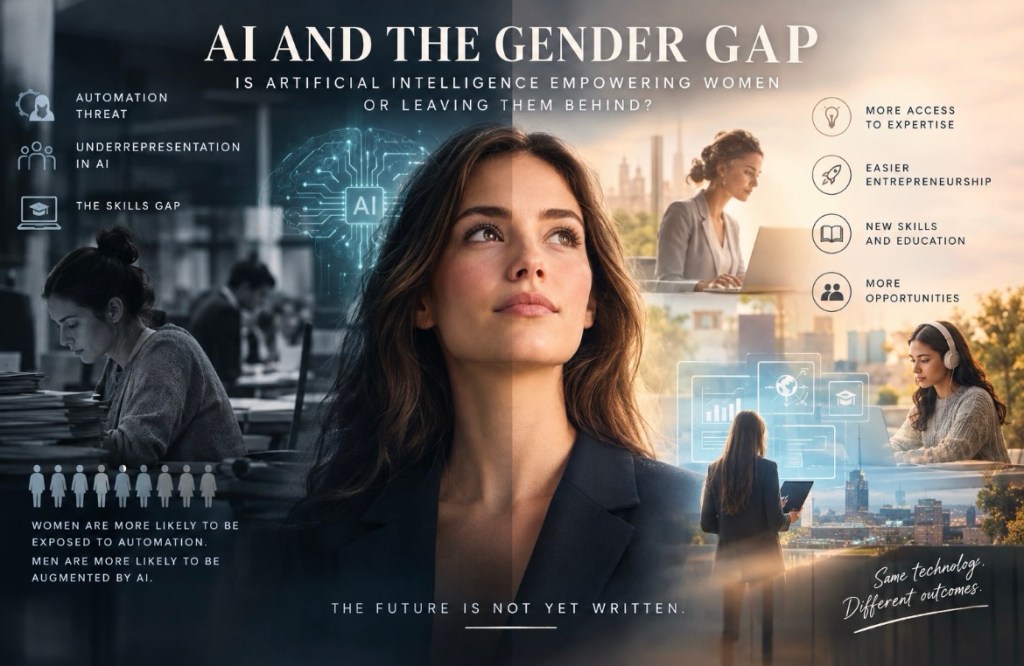
Artificial intelligence promises a future of limitless opportunity. But as machines reshape the workplace, a fundamental question emerges: will AI dismantle centuries of gender inequality, or accelerate it?
Introduction
Artificial intelligence is transforming the world at an extraordinary pace. From finance and healthcare to education, entrepreneurship and journalism, AI is changing how we work, learn and build businesses. It promises greater productivity, new economic opportunities and access to knowledge that was once reserved for specialists.
Yet beneath this technological revolution lies an uncomfortable question: who will benefit most?
Women have spent decades fighting for equal pay, professional recognition, economic independence and leadership opportunities. Now, as AI begins reshaping the global economy, existing inequalities risk becoming embedded in the very systems that will define our future.
My verdict is that AI currently risks amplifying the gender gap more than closing it. However, this outcome is not inevitable. With the right education, policies and access to technology, AI could become one of the most powerful instruments of women’s economic empowerment.
The Automation Threat: Why Women May Be More Vulnerable
One of the greatest concerns surrounding AI is its potential to eliminate or transform existing jobs. Although automation affects workers across genders, its consequences are not distributed equally.
Women are disproportionately represented in administrative, clerical, customer service and support positions. These occupations often involve repetitive tasks such as processing documents, scheduling appointments, managing correspondence and handling routine customer inquiries. Generative AI can increasingly perform or accelerate many of these activities.
Consequently, women working in these sectors may face greater pressure to adapt, retrain or seek new employment.
This does not mean that every job exposed to AI will disappear. Exposure refers to the potential for tasks to change, not necessarily the elimination of an entire occupation. In many cases, AI will assist workers rather than replace them.
Nevertheless, the distinction between replacing and augmenting workers matters enormously. Employees whose work is enhanced by AI may become more productive, command higher salaries and gain access to more senior positions. Those whose tasks are automated may instead experience restructuring, reduced bargaining power or job insecurity.
If women are disproportionately concentrated in roles undergoing automation while men are better represented in roles receiving productivity-enhancing AI tools, the economic consequences could widen the existing divide.
Who Builds AI—and Whose Experiences Count?
Another critical issue concerns the people developing artificial intelligence.
Technology does not emerge in a social vacuum. AI systems are trained on data, shaped by human decisions and deployed within institutions that already contain biases.
When women are underrepresented among developers, researchers, executives and decision-makers, their experiences may receive insufficient attention during the design process.
Consider recruitment software trained on historical hiring decisions. If an employer’s historical data reflects a preference for male candidates in particular technical or leadership positions, an inadequately designed system may reproduce those patterns. Similarly, AI tools used in healthcare, financial services or performance evaluation can produce unfair outcomes when their training data or evaluation methods fail to account for relevant differences between groups.
These problems are not inevitable features of AI. Diverse development teams, representative datasets, independent evaluations and accountability mechanisms can reduce them.
However, representation alone is not enough. Women must also have meaningful influence over how AI is designed, regulated and used.
The issue is therefore not simply whether women use AI, but whether they have a voice in determining the future AI creates.
The AI Skills Gap: An Opportunity at Risk
Access to artificial intelligence is becoming an increasingly important professional advantage.
Workers who understand how to use AI effectively may complete tasks faster, analyze information more efficiently and develop new capabilities. Yet unequal access to training could turn AI literacy into another source of workplace inequality.
In Belgium, PwC’s 2025 research highlighted a substantial gender difference in regular AI use at work, reporting 42% among men compared with 24% among women.
Such figures raise important questions. Are women receiving sufficient AI training from their employers? Do they have equal opportunities to experiment with new technologies? Are professional networks and educational pathways providing the same encouragement to women and men?
Differences in adoption do not automatically demonstrate discrimination, and a single survey cannot explain every cause. Nevertheless, they suggest that organizations should investigate whether access to AI tools, training and professional development is genuinely equitable.
Without deliberate intervention, workers who already possess technological advantages may accumulate further advantages. The result could be a cycle in which access to AI produces higher productivity, stronger career prospects and greater earning potential.
The Other Side: AI as a Tool for Women’s Independence
Despite these risks, focusing exclusively on the dangers would overlook AI’s extraordinary potential.
Artificial intelligence can lower the barriers to entrepreneurship, education and professional development. A woman with limited financial resources can use AI to create a website, research a market, draft a business plan, analyze customer feedback or develop a marketing strategy without immediately hiring an entire team.
For aspiring entrepreneurs, this could make launching a business more accessible and less expensive.
AI can also act as a personal tutor. Women seeking to enter traditionally male-dominated fields can use it to learn programming, explore financial analysis, understand technical concepts and prepare for professional interviews. Workers considering a career change can investigate new industries and practice unfamiliar skills at their own pace.
For women balancing paid employment with disproportionate caring responsibilities, carefully chosen AI tools may reduce administrative workloads and free up time.
These benefits are not automatic. AI tools can make mistakes, reproduce stereotypes and require paid subscriptions, reliable internet access or technical knowledge. Nor can they replace affordable childcare, fair employment practices or equal access to capital.
Still, AI offers something important: the ability to access expertise and execute ideas without always needing the financial resources, institutional connections or large teams that previously made those ambitions difficult to pursue.
That possibility deserves serious attention.
What Must Change?
If governments, businesses and educational institutions want AI to narrow rather than widen gender inequality, several priorities should guide the transition.
First, AI education must become accessible to everyone. Schools should teach students to use AI critically, understand its limitations and recognize algorithmic bias. Girls should be encouraged to explore technology without being treated as exceptions in traditionally male-dominated fields.
Second, employers should provide equal access to AI tools, training and career development. Workers whose responsibilities are being automated should receive opportunities to retrain rather than simply face displacement.
Third, organizations must examine the consequences of AI adoption. Hiring, promotion, pay and redundancy decisions should be monitored for unfair outcomes, with meaningful human oversight and appropriate accountability.
Finally, women need greater representation in AI research, engineering, entrepreneurship and executive leadership. This requires more than encouraging individual ambition; it requires institutions that recognize talent fairly and remove unnecessary barriers to advancement.
The objective should not be to give women a technological advantage over men. It should be to ensure that technological progress does not systematically reward one group while exposing another to disproportionate risks.
Conclusion: The Future Is Not Yet Written
Artificial intelligence is neither inherently feminist nor inherently discriminatory. Its impact depends on who controls it, who can access it and how its benefits and costs are distributed.
At present, existing inequalities in employment, representation and technological adoption create genuine reasons for concern. Women may face greater disruption in certain occupations while remaining underrepresented in the positions that shape AI’s development and economic rewards.
But this is not a predetermined future.
AI could help women establish businesses, acquire new skills, enter lucrative industries and overcome barriers that have historically restricted their independence. Whether these opportunities become widespread will depend on the choices made by educators, employers, governments and individuals today.
The greatest mistake would be to assume that technological progress automatically produces social progress. History offers no such guarantee.
AI did not invent the gender gap. It has the potential to accelerate it—or help dismantle it.
The decisive question is whether society will allow the technology to reproduce existing inequalities or deliberately use it to create a more equitable economy.
Because the future of artificial intelligence is not merely a question of what machines can do. It is a question of who gets to benefit from what they can do.


Leave a Reply