Introduction
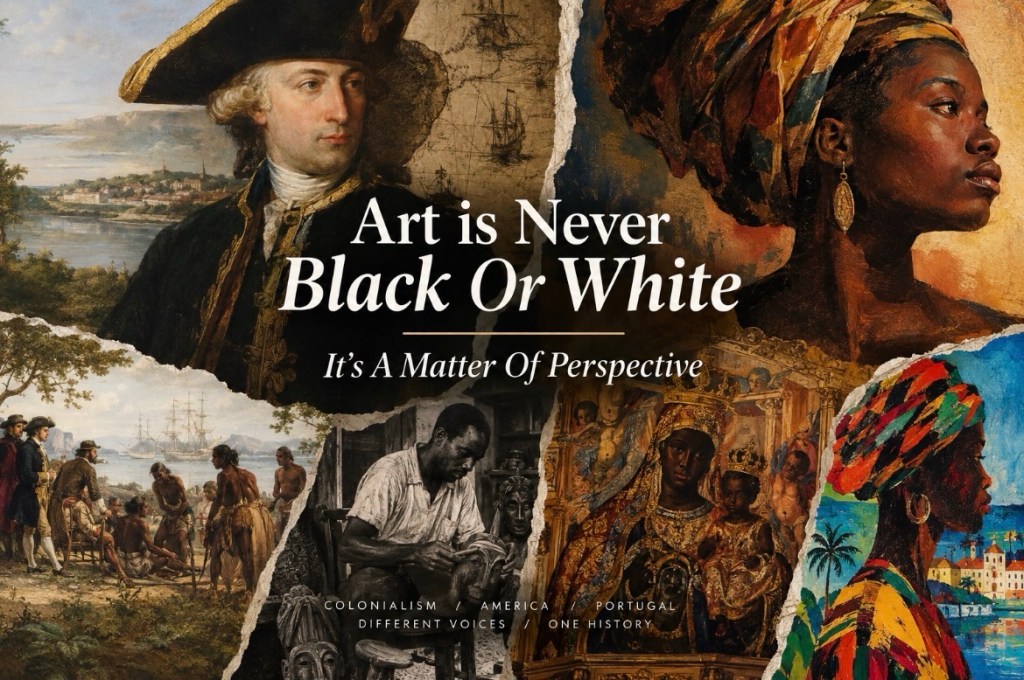
Art has always been more than decoration; it is a reflection of history, identity, power, and lived experience. During the colonial era, artists from both European colonial powers and colonized communities documented the world around them, but they often did so from dramatically different perspectives. The same landscape, event, or individual could be portrayed as a symbol of conquest by one artist and as a story of resilience by another. This contrast reminds us that art is never simply black or white—it is a matter of perspective.
In countries such as the United States and Portugal, colonialism shaped artistic traditions for centuries. White artists often worked within systems that celebrated imperial expansion, religion, and political authority, while Black artists, whether enslaved, freed, or living under colonial rule, used art to preserve culture, express resistance, and reclaim their humanity.
For example, John Singleton Copley’s portrait of Paul Revere presents a prosperous colonial artisan with dignity and refinement, while the engraved frontispiece of Phillis Wheatley in her 1773 book Poems on Various Subjects, Religious and Moral, attributed to Scipio Moorhead, offered one of the earliest visual assertions of Black intellectual presence in America. In Portuguese colonial Brazil, works such as Aleijadinho’s Twelve Prophets at the Sanctuary of Bom Jesus de Matosinhos in Congonhas show how Afro-Brazilian artists transformed Catholic imagery into something deeply local and expressive. Understanding these different viewpoints helps us appreciate not only the artistic achievements of the period but also the complex histories behind them.
American Colonial Art: Two Perspectives
Colonial American art was heavily influenced by European traditions, particularly those of England, France, Spain, and the Netherlands. White artists frequently painted portraits of wealthy landowners, merchants, military leaders, and politicians. These works emphasized social status, prosperity, and the success of colonial society. John Singleton Copley’s portrait of Paul Revere, for instance, does more than record a likeness; it presents Revere as a thoughtful, capable craftsman and citizen, reflecting the values of an emerging colonial elite. Landscapes often portrayed North America as an abundant and “untouched” land, reinforcing the colonial belief that expansion was both justified and inevitable.
However, these paintings often overlooked the realities experienced by enslaved Africans and Indigenous peoples. Their struggles, labor, and contributions were largely absent or reduced to background details.
Black artists in America approached art from a fundamentally different perspective. Many enslaved individuals were denied formal artistic education, yet they expressed creativity through pottery, quilting, woodcarving, ironwork, music, and storytelling. These forms of artistic expression preserved African traditions while adapting to new environments. Rather than celebrating colonial power, their work reflected survival, community, spirituality, and hope. The frontispiece portrait of Phillis Wheatley, attributed to Scipio Moorhead, is a powerful example of this perspective: it visually affirmed the humanity and intellect of a Black woman whose poetry challenged the assumptions of her era.
Following emancipation, Black American artists increasingly used painting and sculpture to challenge stereotypes and document Black life with dignity. Their work highlighted everyday experiences, family relationships, and cultural pride, presenting narratives that had long been ignored by mainstream American art.
Portuguese Colonial Art: Empire and Identity
Portugal built one of the world’s earliest and longest-lasting colonial empires, extending across Africa, South America, and Asia. Portuguese colonial art often celebrated exploration, Christianity, and imperial achievements. Religious paintings, elaborate church decorations, and portraits of colonial officials reinforced the authority of the Portuguese Crown and the Catholic Church.
In Brazil, Angola, Mozambique, Cape Verde, Guinea-Bissau, São Tomé and Príncipe, Goa, and other Portuguese territories, art became a tool of both control and cultural exchange. European artistic techniques blended with local traditions, creating unique styles that reflected diverse influences. The baroque sculptures of Aleijadinho, especially the Twelve Prophets at Congonhas, demonstrate how an artist of African descent working in colonial Brazil could reshape European religious forms into something emotionally powerful and culturally distinct.
White Portuguese artists generally portrayed colonial life from the perspective of empire. Indigenous and African people frequently appeared as supporting figures rather than central subjects. Their cultures were sometimes romanticized or presented through European assumptions rather than authentic representation.
Black artists within Portuguese colonies, however, created works rooted in lived experience. They incorporated African symbolism, oral traditions, and spiritual beliefs into sculptures, textiles, ceramics, and religious art. Even when European artistic styles were adopted, local artists infused them with their own cultural identities. Their creations became quiet acts of resistance, preserving traditions despite colonial attempts at assimilation.
What Differentiates Black and White Colonial Art?
The greatest difference between Black and white artists during colonialism was not simply race but perspective.
White colonial artists often had access to education, financial support, and wealthy patrons. Their work frequently reflected the values of those who commissioned it, celebrating wealth, political authority, exploration, and empire. Many paintings reinforced colonial narratives by presenting European expansion as orderly, civilizing, and successful. In both the American colonies and Portuguese territories, art was often used to legitimize power and make empire appear natural.
Black artists, by contrast, often created under conditions of oppression or exclusion. Their audiences were frequently their own communities rather than elite patrons. Instead of glorifying colonial systems, they documented resilience, memory, spirituality, and identity. Their work preserved cultural heritage that colonial institutions often sought to erase.
Another major difference lies in representation. White artists commonly depicted Black individuals as servants, laborers, or anonymous figures. Black artists portrayed themselves and their communities as complete human beings with families, traditions, emotions, and aspirations. This shift transformed art from an instrument of power into a means of self-definition.
Materials also reflected these differences. Wealthy European artists worked with expensive oils, marble, and commissioned canvases. Black artists often relied on locally available materials such as wood, clay, fabric, metal, beads, and natural dyes. Despite limited resources, they produced works of remarkable creativity and lasting cultural significance.
Shared Influences And Cultural Exchange
Despite these contrasts, colonial art was never entirely divided along racial lines. Centuries of interaction created artistic exchanges that influenced everyone involved. European techniques merged with African craftsmanship, Indigenous knowledge shaped colonial architecture, and local materials transformed imported artistic traditions.
In Portuguese colonies especially, Afro-Portuguese religious art combined Catholic imagery with African aesthetics. The churches and sculptures of colonial Brazil show how enslaved and free Black artisans helped shape the visual culture of empire even while living under it. Similarly, in the United States, African artistic traditions influenced decorative arts, architecture, music, and eventually modern American visual culture.
These cultural exchanges demonstrate that colonial art was not simply the product of one group imposing ideas on another. Instead, it evolved through constant interaction, adaptation, and negotiation between different peoples and traditions.
Conclusion
Colonial art reveals that history is rarely told through a single voice. White artists often documented the ambitions and ideals of expanding empires, while Black artists captured stories of endurance, identity, and cultural survival. Both perspectives are valuable, but they tell different truths about the same historical period.
Looking at American and Portuguese colonial art side by side reminds us that every artwork reflects the experiences, beliefs, and circumstances of its creator. Understanding these diverse perspectives allows us to move beyond simple labels of right or wrong, black or white. Instead, we begin to see art for what it truly is: a conversation between cultures, histories, and human experiences.
Ultimately, art is never black or white—it is a matter of perspective. By studying the works of both colonizers and the colonized, we gain a richer understanding of the past and a greater appreciation for the many voices that continue to shape the story of art today


Leave a Reply