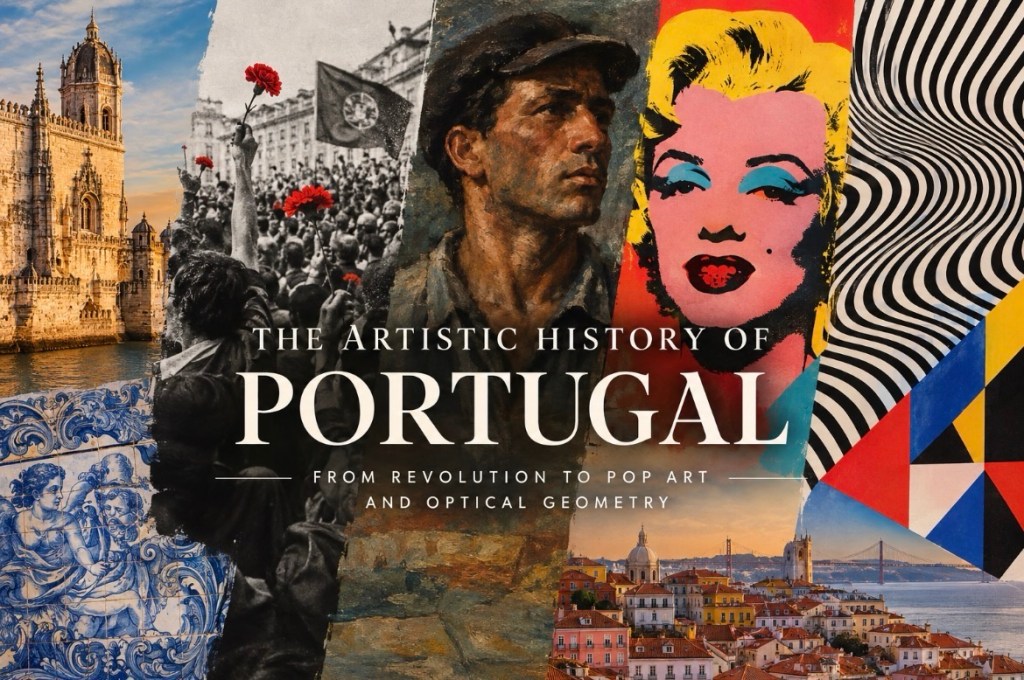
Portugal’s artistic history is a fascinating journey through centuries of cultural transformation, political resistance, and creative experimentation. While the country is internationally celebrated for its traditional azulejo tiles, Manueline architecture, and religious art, its modern artistic landscape reveals a more rebellious and experimental side. From revolutionary movements that challenged established power to New Realism, Pop Art, and Optical Geometry, Portuguese artists continually redefined the relationship between art and society. Their works reflect a nation navigating dictatorship, revolution, modernization, and its place in an increasingly interconnected world.
Revolution and Artistic Resistance
For much of the twentieth century, Portuguese artistic expression developed under the influence of political censorship and authoritarian rule. The Estado Novo dictatorship, established under António de Oliveira Salazar in the 1930s, imposed conservative cultural ideals and restricted freedom of expression. Artists, writers, and intellectuals frequently faced limitations on what they could communicate publicly.
Despite these restrictions, art became an important means of questioning authority and expressing dissatisfaction with the established order. Modernist artists explored new visual languages, while others used symbolism, abstraction, and social commentary to challenge conventional expectations.
The Carnation Revolution of 25 April 1974 marked a decisive turning point. The peaceful military-led uprising ended decades of dictatorship and opened Portugal to democracy and greater artistic freedom. With censorship abolished, artists gained new opportunities to address previously restricted subjects, including political oppression, social inequality, workers’ rights, and national identity.
The revolution transformed not only Portugal’s political institutions but also its cultural imagination. Art became a space in which Portuguese society could reconsider its past, confront its contradictions, and envision a different future.
2. New Realism: Art Reflecting Society
New Realism emerged internationally as a movement concerned with representing contemporary life and the social conditions surrounding it. In Portugal, socially engaged realist approaches became particularly relevant during periods of political repression, economic inequality, and democratic transition.
Portuguese artists increasingly turned their attention towards ordinary people, working-class communities, and the realities of everyday existence. Rather than concentrating exclusively on idealized beauty or traditional artistic subjects, they explored the struggles and experiences that shaped Portuguese society.
This approach reflected a broader belief that art could serve as a form of social observation and criticism. Paintings, photographs, and other visual works could reveal inequalities that political institutions preferred to overlook, giving visibility to marginalized communities and challenging official narratives.
It is important, however, to distinguish New Realism from Portuguese Neo-Realism, a significant literary and cultural movement that developed particularly during the 1930s and 1940s. Influenced by social concerns and Marxist thought, Neo-Realism examined poverty, class divisions, and working-class life under the dictatorship. Although it was not identical to international New Realism, its emphasis on social reality helped establish a lasting tradition of politically engaged artistic expression in Portugal.
Following the revolution, these concerns acquired renewed significance. Artists could investigate the complexities of Portuguese society with greater openness, exploring the relationship between individual experience, collective memory, and political change.
3. Pop Art: Consumer Culture and Modern Identity
Pop Art emerged in Britain and the United States during the 1950s and gained international prominence throughout the 1960s. By incorporating imagery from advertising, consumer products, popular entertainment, and mass media, artists challenged traditional distinctions between fine art and everyday visual culture.
In Portugal, the development of Pop Art and related contemporary practices unfolded within a distinctive historical context. The country experienced profound political and social transformations during the 1960s and 1970s, as well as increasing exposure to international artistic developments.
Pop-inspired approaches offered new ways to examine consumerism, celebrity, commercial imagery, and the influence of mass communication. Familiar visual elements could be transformed into works that questioned how modern identities were constructed and how images shaped public perception.
The movement also challenged conventional ideas about originality and artistic value. By borrowing from popular culture, artists questioned whether art needed to remain exclusive, prestigious, or detached from ordinary life.
In Portugal, these international influences contributed to a broader diversification of contemporary artistic expression. Artists increasingly experimented with new materials, visual references, and interdisciplinary practices, helping connect Portuguese art to wider international conversations.
Pop Art therefore represented more than a change in visual style. It reflected the growing importance of mass media and consumer culture in a society undergoing rapid modernization.
4. Optical Geometry: Art, Perception, and Precision
While socially engaged realism focused on recognizable human experiences and Pop Art explored popular imagery, Optical Art and geometric abstraction pursued a different objective: understanding how visual forms influence human perception.
Optical Art, often called Op Art, became internationally prominent during the 1960s. Artists used carefully arranged lines, contrasting colors, repeated patterns, and geometric shapes to create the illusion of movement, vibration, depth, or instability on flat surfaces.
Geometric abstraction, a broader artistic approach, emphasized structure, proportion, rhythm, and mathematical relationships rather than recognizable subjects. These practices reflected a growing interest in the relationship between art, science, psychology, and design.
In Portugal, geometric and optical approaches formed part of a wider engagement with international modernism and experimental visual languages. They complemented the country’s more figurative and politically engaged artistic traditions, demonstrating that Portuguese contemporary art could participate in highly formal and conceptual investigations.
Such works invite viewers to become active participants. The apparent movement of a pattern depends on how the eye processes contrast, repetition, and spatial relationships. Art becomes an experience rather than simply an image to observe.
Optical geometry also connects naturally with architecture, graphic design, and contemporary visual communication, where proportion and repetition influence how spaces and images are experienced.
5. A Continuing Artistic Transformation
The history of modern Portuguese art cannot be reduced to a single movement or political event. Revolution, realism, Pop Art, and geometric experimentation represent different responses to changing historical circumstances, artistic debates, and social expectations.
Some artists have sought to expose injustice and preserve collective memory. Others have investigated popular culture, experimented with abstraction, or explored the boundaries between art and technology. Together, these approaches demonstrate the diversity of Portugal’s artistic identity.
Today, Portuguese artists continue to engage with questions of globalization, migration, environmental change, urban development, and national identity. Contemporary galleries, museums, independent spaces, and international exhibitions provide platforms for experimentation and dialogue.
Conclusion
Portugal’s artistic evolution reveals a nation continually redefining its creative identity through resistance, transformation, and innovation. From revolutionary movements that challenged tradition to socially engaged realism, Pop Art, and Optical Geometry, Portuguese artists have explored new ways of understanding society and visual experience. These movements demonstrate how art can document political change, question cultural conventions, and experiment with perception itself. More than a record of aesthetic developments, Portugal’s artistic history is a reflection of its changing society. Its enduring significance lies in the ability of artists to preserve cultural memory while imagining new possibilities for the future.


Leave a Reply