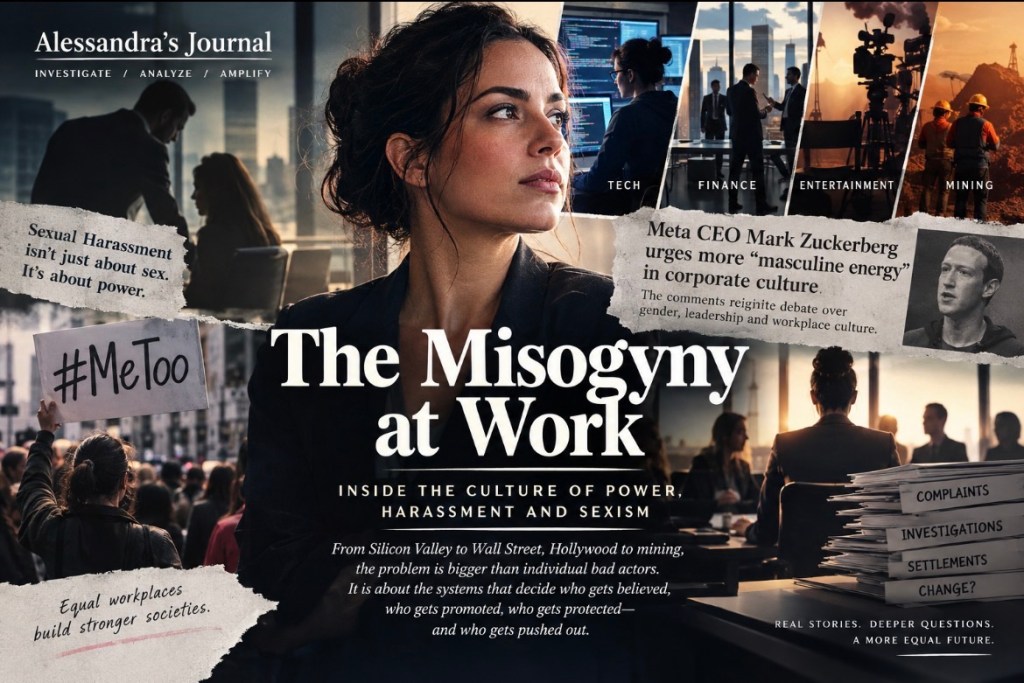
From Silicon Valley to Wall Street, Hollywood to mining, the problem is bigger than individual bad actors. It is about the systems that decide who gets believed, who gets promoted, who gets protected—and who gets pushed out.
There is a particular moment that happens again and again in the corporate world.
A woman reports inappropriate behaviour. HR investigates. Lawyers become involved. A statement is released. The company promises change.
And then the headlines disappear.
But sexual harassment rarely begins with a lawsuit. It begins much earlier: with the joke that everyone is expected to tolerate, the executive whose behaviour is excused because he is “too valuable” to lose, the woman labelled “difficult” for speaking up, the promotion that quietly goes to someone else, or the culture in which aggression is interpreted as leadership.
That is where the investigation into workplace misogyny really begins.
A Problem Older Than The Modern Corporation
Sexual harassment is not a new phenomenon. What has changed is the willingness—and ability—to challenge it.
For decades, workplaces were structured around assumptions that men were the natural leaders while women were secondary participants. Women entering traditionally male professions were often expected to adapt to the culture rather than question it.
American employment law gradually began to recognize that sexual harassment could constitute sex discrimination. In Meritor Savings Bank v. Vinson in 1986, the U.S. Supreme Court recognized hostile-work-environment sexual harassment under Title VII.
But legal recognition did not eliminate the culture that produced harassment.
Because harassment is rarely just about sex.
It is about power.
The Industries Where Power Becomes Particularly Concentrated
Look across industries and the pattern becomes difficult to ignore.
In technology, gaming and venture capital, enormous financial rewards can be concentrated among relatively small groups of executives, founders and investors.
In finance, extreme competition, long hours and hierarchical structures have historically rewarded aggressive behaviour.
In entertainment, careers can depend upon producers, directors, agents and executives controlling access to opportunities.
In mining and other traditionally male-dominated industries, workers may spend weeks in remote environments where hierarchy and workplace culture become particularly powerful.
And in academia, young researchers can depend upon senior professors for recommendations, funding, publications and career opportunities.
The environments are different. The underlying vulnerability can be remarkably similar.
The National Academies found sexual harassment to be common among women in academic, science, engineering and medicine, while emphasizing that institutions must address organizational culture—not simply comply with the law. Its review found that harassment can contribute to women leaving organizations and careers altogether.
That is the part of the story that statistics about individual incidents can obscure.
Harassment doesn’t only hurt the person experiencing it. It changes who remains in the industry.
The Silence Problem
One of the biggest misconceptions about workplace harassment is that serious misconduct automatically produces a formal complaint.
It doesn’t.
The U.S. Equal Employment Opportunity Commission has noted that workplace harassment frequently goes unreported. Between fiscal years 2018 and 2021, the EEOC received 27,291 charges alleging sexual harassment, but those figures represent only cases that entered the formal system.
Why don’t people report?
Because reporting can be expensive.
There can be fear of retaliation, career damage, social isolation, embarrassment or simply not being believed.
And sometimes the alleged harasser has something the organization desperately wants: money, influence, clients, technical expertise, celebrity or political connections.
That creates a dangerous calculation:
Is protecting the employee more valuable than protecting the person who generates results?
History suggests that organizations have not always chosen the employee.
When “High Performance” Becomes An Excuse
This is where academic research on workplace culture becomes particularly interesting.
Researchers Jennifer Berdahl and colleagues have developed the concept of a “masculinity contest culture”—workplaces where employees compete through characteristics traditionally associated with masculinity: toughness, dominance, extreme work hours, refusing to show weakness and ruthless competition.
Their research links these cultures with toxic leadership, bullying, harassment, burnout and intentions to leave the organization. (DOI)
This changes the question.
Instead of asking:
“Why did this man behave badly?”
we can also ask:
“What kind of behaviour did this organization reward?”
That distinction matters.
A company can have one abusive employee.
But if several people know about the behaviour, HR knows about it, senior management knows about it—and nothing happens because the person is considered indispensable—then the problem is no longer simply an individual.
It is institutional.
Silicon Valley And The Return Of The “Alpha CEO”
This brings us to one of the more controversial recent debates surrounding corporate culture.
In 2025, Mark Zuckerberg argued that corporate culture had become too “culturally neutered” and called for more “masculine energy” in business.
The controversy was not simply about one CEO using the word “masculine.”
It raised a deeper question:
What exactly do we mean when we say that leadership should become more masculine?
If the answer is confidence, ambition, courage and competitiveness, none of those qualities belong exclusively to men.
But if “masculine” becomes shorthand for aggression, dominance, emotional suppression, extreme competition and refusing to compromise, the consequences are different.
Research on masculinity-contest cultures suggests that these behaviours can create dysfunctional organizations rather than better ones.
The irony is striking.
Corporate America spent years trying to convince women that they needed to become more aggressive to succeed.
Now, some of the same corporate culture is being criticized for becoming too aggressive.
Perhaps the problem was never that women were insufficiently masculine.
Perhaps the problem was the definition of leadership itself.
From Activision Blizzard to Rio Tinto
The pattern becomes even clearer when looking at major corporate controversies.
In the Activision Blizzard case, California authorities alleged sex discrimination, harassment and unequal treatment of women. The case ultimately produced a roughly $54 million settlement, with measures addressing pay and promotion practices.
In the mining industry, Rio Tinto commissioned an independent review of its workplace culture. More than 10,000 people participated in the process. The resulting report found systemic bullying and sexism and reported that 28.2% of women surveyed had experienced sexual harassment in the previous five years. It also documented reports of attempted or actual rape or sexual assault.
Rio Tinto subsequently launched its “Everyday Respect” program and reported progress, while acknowledging that harmful behaviour had not disappeared.
These cases reveal something important about corporate reform.
A policy can be changed overnight.
A culture cannot.
The Media Changed The Equation
Then came #MeToo.
Beginning in 2017, stories that might previously have remained private suddenly became public.
The result was not simply a wave of accusations. It was a change in the economics of silence.
Companies discovered that reputational damage could become enormous.
Employees discovered that they were not necessarily alone.
The public discovered how frequently powerful people had been protected by institutions.
But the media can also simplify complicated systems into individual villains.
A CEO resigns.
A celebrity is cancelled.
A company issues an apology.
The story becomes:
“One bad man.”
And the investigation ends.
The harder question is:
Who knew?
Who promoted him?
Who ignored complaints?
Who signed the settlement?
Who was afraid to speak?
Who benefited?
And how many women left before anyone listened?
The Cost Nobody Puts On The Balance Sheet
The economic consequences of misogyny are difficult to calculate because the biggest losses are often invisible.
A woman leaves an industry.
A student abandons a scientific career.
An employee stops applying for promotion.
A talented researcher chooses another field.
A young woman decides that finance, technology, mining or entertainment simply isn’t worth entering.
There is no lawsuit for the career that never happened.
There is no corporate report documenting the employee who quietly disappeared.
But the National Academies has documented the relationship between harassment and reduced professional advancement, disengagement and intentions to leave.
That makes workplace misogyny more than a women’s issue.
It is a talent issue.
An economic issue.
A leadership issue.
And ultimately, a societal issue.
So Where Do We Go From Here?
The solution cannot simply be another mandatory training session.
Research increasingly points toward structural change: credible reporting mechanisms, protection against retaliation, transparency, accountability for senior employees, better organizational climates and less dependence on individual managers having unchecked power.
Companies need to stop asking only whether something is technically illegal.
They should also ask:
Is this the kind of environment in which people can thrive?
Because legality is the minimum standard.
Respect should be the ambition.
The real measure of progress will not be how many companies publish statements about equality.
It will be whether a young woman can enter a boardroom, laboratory, newsroom, mine, investment bank, film studio or technology company and know that her career will depend on her talent—not her ability to tolerate someone else’s abuse.
The story of workplace misogyny is therefore not simply a story about men behaving badly.
It is a story about power.
About institutions.
About silence.
And about what happens when an entire culture decides that winning matters more than the people who are being pushed aside.
The question is no longer whether these cultures exist.
The question is whether we are willing to dismantle them.


Leave a Reply