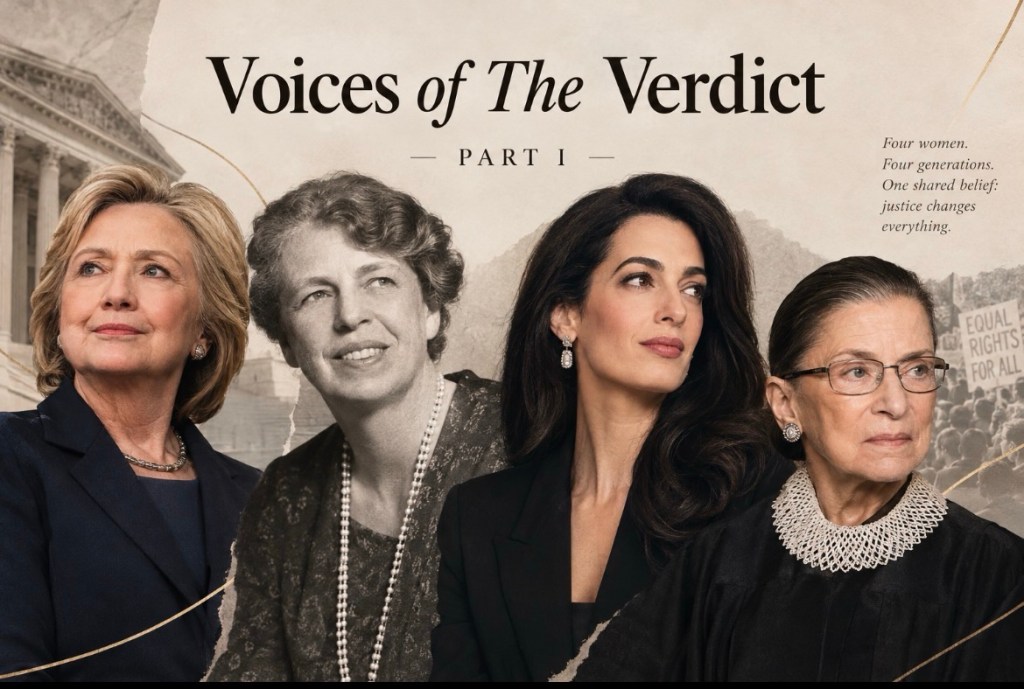
The history of law and international relations has often been written in the voices of men, yet some of the most transformative decisions, treaties, and human rights victories have been shaped by women who challenged entrenched systems. These pioneers not only broke barriers but also redefined what leadership looks like on the global stage. Their work reminds us that justice is not merely a concept—it is a practice carried forward by courageous individuals.
Hillary Clinton
One of the most visible figures in modern diplomacy is Hillary Clinton. As U.S. Secretary of State, she championed the idea that women’s rights are human rights, embedding gender equality into American foreign policy. Her advocacy helped mainstream the notion that global security cannot exist without social justice, and that diplomacy must include marginalized voices.
Ruth Bader Ginsburg
In the realm of law, few names carry the moral weight of Ruth Bader Ginsburg. As a U.S. Supreme Court Justice, she dismantled legal structures that normalized gender discrimination. Through carefully crafted judgments, she proved that equality under the law is not symbolic—it is enforceable. Her legacy continues to inspire legal professionals worldwide.
Amal Clooney
International law also found a powerful advocate in Amal Clooney. Known for representing victims of mass atrocities and political repression, she bridges courtroom advocacy with global awareness. Her work at international courts demonstrates how legal mechanisms can confront war crimes, protect journalists, and hold powerful states accountable.
Eleanor Roosevelt
Long before the modern human rights movement, Eleanor Roosevelt laid its foundation. As chair of the committee that drafted the Universal Declaration of Human Rights, she transformed abstract ideals into a living document. Her diplomacy was rooted in empathy, proving that soft power can achieve lasting global impact.
Conclusion
Together, these four women illustrate that law and diplomacy are not static systems—they evolve through human agency. Each pioneer faced resistance, skepticism, and structural inequality, yet persisted in reshaping global norms. Their stories are not merely inspirational; they are instructional. They teach us that justice requires presence, voice, and persistence.
“Voices of the Verdict” is ultimately about more than individual success. It is about how collective courage transforms institutions. These women did not just enter the halls of power—they changed the language spoken within them. And in doing so, they left behind a world where the verdict of history increasingly recognizes women not as exceptions, but as essential architects of global justice.


Leave a Reply