Michelle Bachelet
From Latin America, Michelle Bachelet stands out as both a political leader and a human rights champion. As President of Chile and later UN High Commissioner for Human Rights, she placed dignity and accountability at the center of governance. Her leadership showed how national experience can inform global human rights policy.
Madeleine Albright
Diplomacy at the highest levels was reshaped by Madeleine Albright, the first woman to serve as U.S. Secretary of State. A refugee turned diplomat, she brought moral urgency to foreign policy, arguing that power must be exercised with ethical responsibility. Her career symbolized how personal history can shape global perspective.
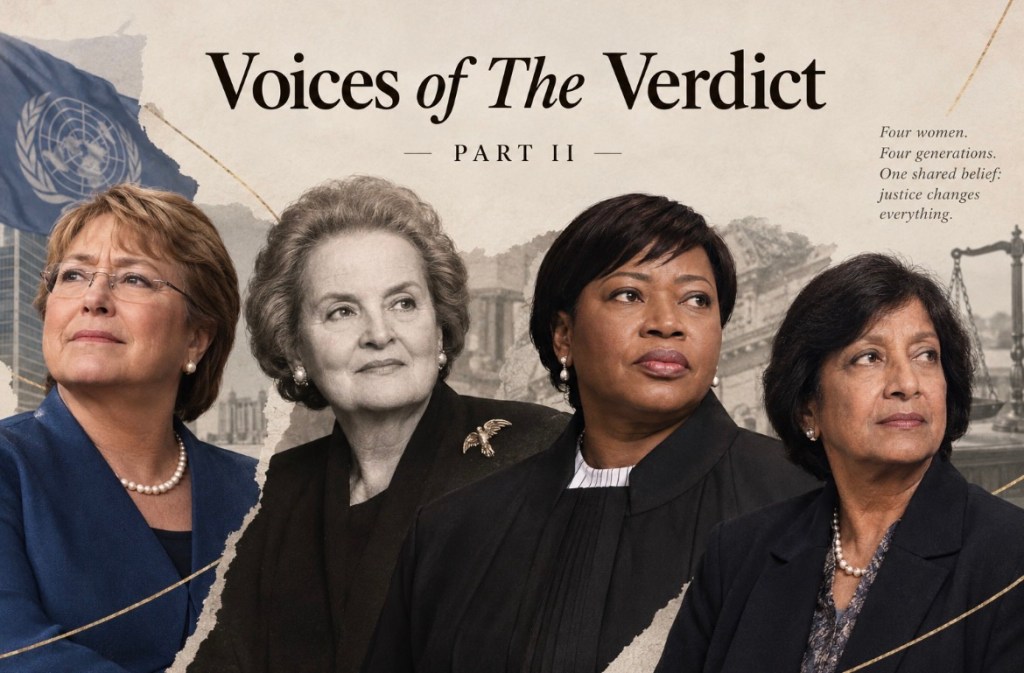
Fatou Bensouda
In Africa, international justice gained momentum through Fatou Bensouda, former Chief Prosecutor of the International Criminal Court. She pursued cases involving genocide and crimes against humanity, often under immense political pressure. Her tenure demonstrated that even the most powerful individuals can be subject to legal scrutiny.
Navi Pillay
Another towering figure in international law is Navi Pillay. Having grown up under apartheid in South Africa, she later served as a judge at the International Criminal Tribunal for Rwanda and as UN High Commissioner. Her work reinforced the idea that law must serve as a shield for the vulnerable.
Conclusion
Together, these women illustrate how global leadership now takes many forms: courtroom advocacy, economic reform, constitutional judgment, peace activism, and institutional diplomacy. What unites them is not status, nationality, or ideology—but a commitment to justice as something lived, defended, and negotiated every day.
Part Two of Voices of the Verdict shows that women are no longer simply entering international systems—they are reshaping their foundations. They bring perspectives grounded in experience, empathy, and accountability. And as global challenges grow more complex—from climate change to armed conflict—the world increasingly turns to leaders who understand that law and diplomacy are not about power alone, but about responsibility.
Their voices expand the verdict of history: justice is strongest when it is inclusive, and diplomacy is most effective when it reflects the full diversity of humanity.


Leave a Reply