If the first generation of pioneers proved that women belong in the halls of global power, the next generation has shown how deeply they can transform those spaces. Across courts, foreign ministries, peace negotiations, and international institutions, women continue to redefine what justice, diplomacy, and leadership mean in practice. These ten voices expand the chorus of global influence, reminding us that progress is not a single moment—but an ongoing movement.
Carla Del Ponte
A towering figure in global criminal justice is Carla Del Ponte. As Chief Prosecutor for the International Criminal Tribunals for the former Yugoslavia and Rwanda, she pursued some of the most complex war crimes cases in modern history. Her work brought perpetrators of genocide and ethnic cleansing before international courts, helping establish the principle that no atrocity is beyond legal accountability.
Brenda Hale
One of the most powerful legal voices in Europe is Brenda Hale, the first woman to serve as President of the UK Supreme Court. She presided over landmark constitutional cases, including those concerning Brexit. Her judgments highlighted how the rule of law protects democratic institutions—even during periods of political uncertainty.
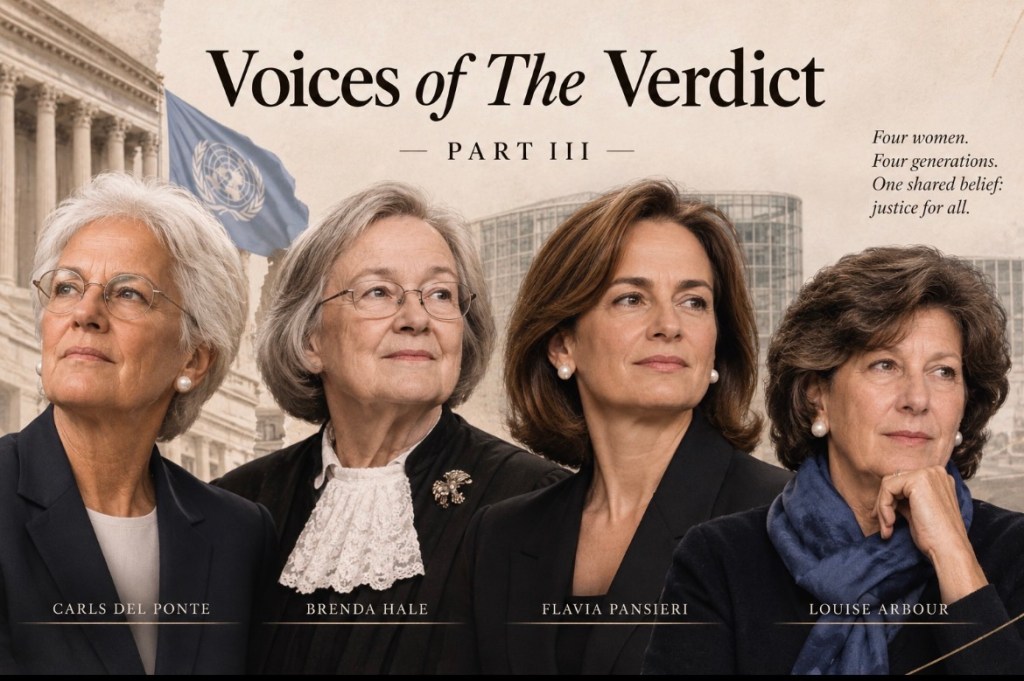
Flavia Pansieri
Global justice also owes much to Flavia Pansieri, who spent decades strengthening international human rights mechanisms. Through diplomatic engagement and institutional reform, she helped bridge the gap between legal standards and real-world enforcement, ensuring that international law translates into lived protection.
Louise Arbour
Another transformative figure is Louise Arbour. Formerly a justice of the Supreme Court of Canada, she later served as UN High Commissioner and as a prosecutor at international tribunals. Her career uniquely bridged domestic constitutional law and global human rights enforcement.
Conclusion
Voices of the Verdict – Part Three reminds us that justice is not a destination but a process, constantly redefined by those who dare to challenge old assumptions. These women show that the future of international relations will not be built only by states, but by individuals who understand that true authority comes from legitimacy, empathy, and the courage to imagine a more equitable world.


Leave a Reply