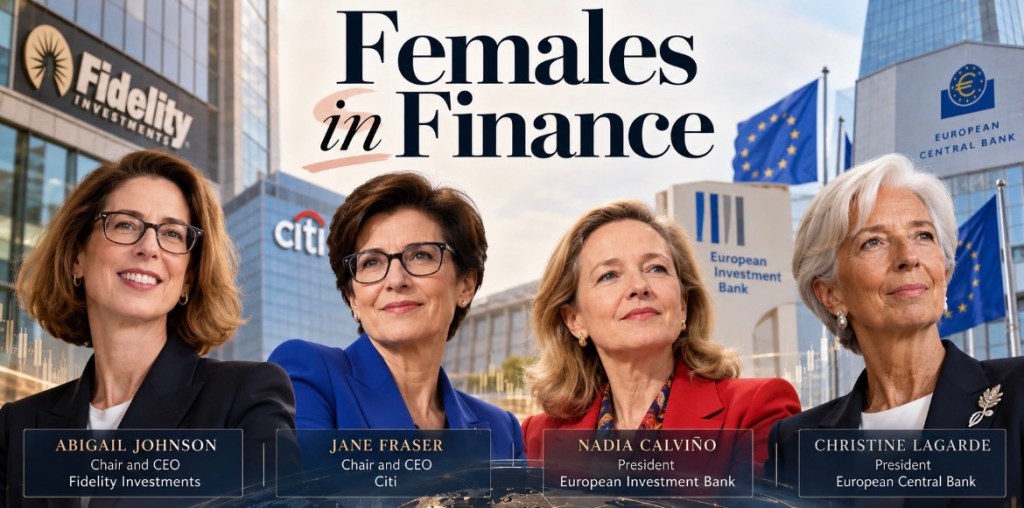
For generations, finance has been perceived as a man’s world. From investment banking and asset management to monetary policy and international economic strategy, women have had to navigate institutions where leadership positions were historically dominated by men. Today, however, women are increasingly shaping the decisions that influence markets, businesses and the financial lives of millions.
Among these influential leaders are Abigail Johnson, Jane Fraser, Nadia Calviño and Christine Lagarde. Each has built a remarkable career in a different corner of the financial world. Their stories demonstrate that finance is not simply about money: it is about power, responsibility, innovation and the ability to shape the future.
Abigail Johnson: The Architect of Investment
Abigail Johnson is the chair and chief executive officer of Fidelity Investments, one of the world’s major financial services companies. Having joined the business in 1988, she spent decades gaining experience across different areas of the organisation before becoming CEO in 2014.
Under her leadership, Fidelity has continued to develop its investment and wealth management services, serving individuals, institutions and businesses. The company operates across brokerage, retirement planning, investment funds and other financial services, helping clients manage and grow their assets.
Johnson’s career is particularly interesting because it combines family-business succession with the challenges of leading a major financial institution in a rapidly changing industry. As technology transforms investing, financial companies must adapt to digital platforms, changing customer expectations and emerging investment opportunities.
Her leadership illustrates the importance of long-term thinking in wealth creation. Successful investing requires discipline, risk management and an understanding of how markets evolve. For aspiring female entrepreneurs and investors, Johnson’s journey offers a valuable lesson: building financial influence often requires years of learning, strategic decision-making and consistent execution.
Jane Fraser: Breaking Barriers in Banking
Jane Fraser became chief executive officer of Citigroup, commonly known as Citi, in March 2021. She made history as the first woman to lead one of the major Wall Street banks. In October 2025, she also became chair of Citi’s board.
Born in Scotland, Fraser studied economics at the University of Cambridge before earning an MBA from Harvard Business School. She began her career at Goldman Sachs and later worked at McKinsey & Company before joining Citi in 2004.
Throughout her career at Citi, Fraser held senior positions in strategy, consumer banking and other business divisions. Her experience reflects the complexity of international banking, where executives must balance profitability, regulatory requirements, technological change and the needs of customers across different markets.
Leading a global bank is not simply a matter of managing money. It involves overseeing risk, maintaining financial stability, navigating economic uncertainty and making decisions that affect businesses and communities worldwide.
Fraser’s appointment represents a significant milestone for women in corporate leadership. Yet her story also highlights the continuing importance of expertise, experience and accountability in senior financial positions.
Nadia Calviño: Financing Europe’s Future
Nadia Calviño is a Spanish economist and lawyer who became president of the European Investment Bank (EIB) in January 2024, making her the first woman to hold the position.
Before joining the EIB, Calviño served as Spain’s economy minister and first vice-president. She also held senior positions at the European Commission, gaining extensive experience in European economic policy, financial services and public administration.
The European Investment Bank plays an important role in financing projects that support economic development, innovation, infrastructure and the energy transition. Its investments can help businesses expand, communities modernise and countries develop more sustainable economies.
Calviño’s position therefore places her at the intersection of finance and public policy. Decisions about investment are not only financial calculations; they can also influence employment, technological progress and Europe’s long-term competitiveness.
Her career demonstrates that financial leadership extends beyond private banks and investment funds. Public financial institutions also play a major role in determining which projects receive funding and how capital contributes to society.
For women interested in economics, international affairs or sustainable development, Calviño offers an example of how technical expertise and public leadership can combine to influence an entire continent.
Christine Lagarde: The Woman Behind the Euro
Christine Lagarde is one of the most recognisable figures in international finance. Since November 2019, she has served as president of the European Central Bank (ECB), becoming the first woman to lead the institution.
A French lawyer by training, Lagarde previously served as France’s minister of economy and finance and as managing director of the International Monetary Fund (IMF). Her career has taken her from international law to national government and the highest levels of global economic governance.
The ECB is responsible for monetary policy in the euro area, with its primary objective being price stability. Its decisions about interest rates influence borrowing costs, savings, business investment and the wider economy.
When inflation rises or economic conditions change, the ECB must assess the available evidence and determine an appropriate policy response. These decisions can affect households purchasing homes, companies financing expansion and savers deciding how to manage their money.
Lagarde’s work illustrates the importance of economic judgement in a complex and interconnected world. Monetary policy requires careful analysis, clear communication and an understanding of how financial decisions influence millions of people.
Her career also represents a historic shift in international leadership, demonstrating that women can occupy positions at the centre of global economic decision-making.
The Future of Female Finance
Abigail Johnson, Jane Fraser, Nadia Calviño and Christine Lagarde operate in different institutions, but their careers share a common theme: the power to influence how money moves through the economy.
Johnson leads in investment management. Fraser operates at the heart of international banking. Calviño oversees a major institution financing European development, while Lagarde helps guide monetary policy across the euro area.
Their achievements deserve recognition, but their stories should also encourage a broader conversation about opportunity, representation and access to financial education. Leadership alone cannot eliminate every barrier women encounter in finance, and progress requires institutions that support talent, fairness and professional development.
For the next generation, financial literacy is an essential starting point. Understanding investing, banking, interest rates and economic policy allows individuals to make better decisions and participate more confidently in financial conversations.
The future of finance will be shaped by technological innovation, sustainability, global competition and changing economic conditions. Women will be part of those conversations not simply as symbols of progress, but as economists, investors, entrepreneurs and decision-makers.
Finance’s fearless females remind us that money is more than a measure of wealth. It is a tool that can influence opportunity, shape societies and determine what becomes possible.
And the next chapter of financial leadership is still being written.


Leave a Reply