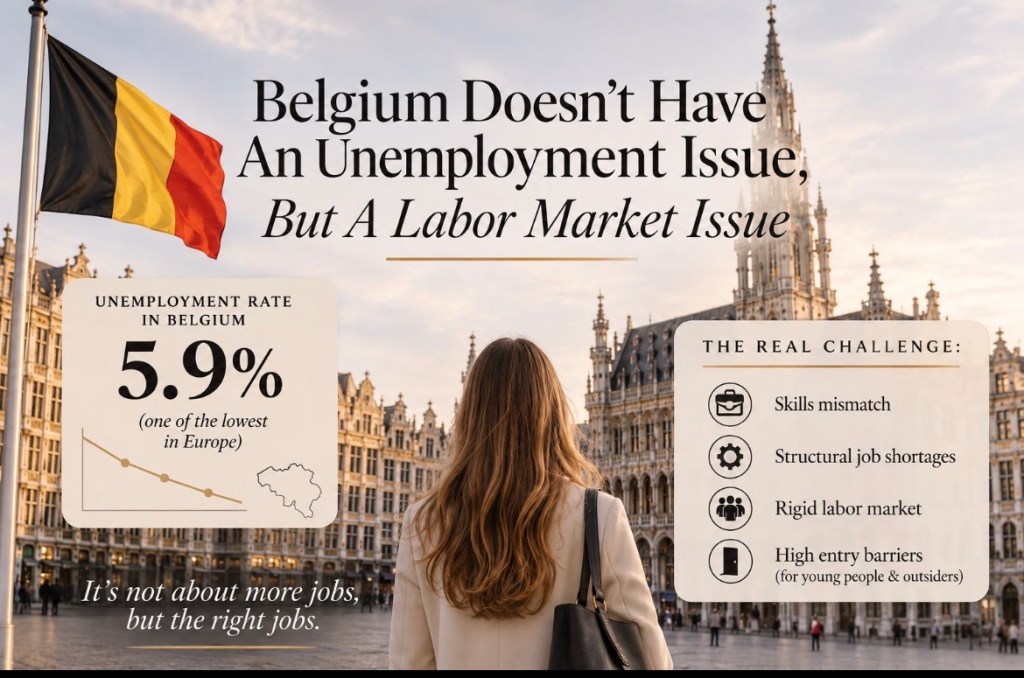
Belgium belongs to the riches countries of Europe. The economy is strong, the salaries belong to the highest of the European Union, and still the companies keep investing. But still, our country faces a remarkable paradox: while thousands of employers are unable to fill job openings, hundreds of thousands of Belgians remain jobless.
According to Statbel and the RVA, the number of job seekers fluctuate between 350.000 and 360.000 people.
At the same time, according to VDAB, Forem, and Actiris, there were more than 170,000 job openings in 2024, a large proportion of which are considered to be in shortage occupations. In Flanders alone, more than 60% of job openings each year are in shortage occupations.
This raises a fundamental question: How can a country have both a labor shortage and a large pool of job seekers?
The answer does not lie in a single cause. Belgium is not facing a simple unemployment problem, but rather a series of structural problems that reinforce one another.
A Labor Market Divided Into Three Regions
One of the first challenges is that Belgium does not actually have a unified labor market. Although Belgium is small, Flanders, Wallonia, and Brussels function as three distinct labor markets.
● Flanders: unemployment around 3 to 4% (among the lowest in Europe)
● Wallonië: around 8 to 10%
● Brussel: usually above 12%, with youth unemployment going to 20%+
This difference is huge within such small geographical distance.
A concrete example:
In the Antwerp and Ghent region, there are thousands of job openings in logistics, engineering, and healthcare. At the same time, there are tens of thousands of job seekers in Brussels alone, but only a fraction of them have the right language skills, mobility, or education to fill those jobs.
The Mismatch Between Education and Job Openings
Perhaps the biggest structural problem is the mismatch.
According to VDAB, about half of all job openings each year are in shortage occupations. This means positions for which there is a chronic shortage of candidates.
Examples of occupations facing labor shortages since 2024:
● nurses (shortages of thousands per year)
● technical employees (elektriciens, onderhoudstechniekers)
● vrachtwagenchauffeurs (geschat tekort: >5.000)
● IT-specialisten (structureel tekort in cybersecurity en softwareontwikkeling)
● teachers (especially in STEM and languages)
At the same time, every year thousands of young people graduate with degrees in fields for which there is less immediate demand, such as certain humanities disciplines or general degrees without a specialization.
This does not mean that these programs are “worthless,” but it does mean that the job market has shifted significantly toward: health care, technology, digitization, and logistics.
The Transition From School Benches To Work Places Remain Difficult
In Belgium, the transition from school to work takes longer on average than in neighboring countries.
In Germany, a large proportion of young people find work within three months through the dual system. In Belgium, the transition takes 6 to 12 months for many young people, especially those without work experience.
A specific problem: An 18-year-old who graduates without any internship experience often has a lower chance of finding immediate employment than a German peer who has already spent two years working at a company.
Teenagers Pay The Highest Price
Youth unemployment is consistently higher than the average.
In Belgium, youth unemployment stands at around 15%. In Flanders, it is often around 10–12%. In Brussels, it can reach 20–25%.
For young people without a high school diploma, the risk is even greater: they are 3 to 4 times more likely to face long-term unemployment.
Furthermore, OECD research shows that a period of unemployment during the first five years of a career can lead to a 20% reduction in lifetime earnings, less stable careers, and a higher risk of repeated unemployment.
Education And Economy Grow Apart
The economy is changing faster than education.
In 2010, there were approximately 50,000 IT job openings in Belgium. By 2024, that number will have more than doubled, with a structural shortage of thousands of candidates.
According to the Flemish government, more than 30,000 additional healthcare workers will be needed by 2030 due to the aging population.
Nevertheless, enrollment in these programs remains insufficient.
In addition, many students still choose general programs, while technical and vocational programs often lead to greater job security, faster employment, and a lower risk of unemployment.
Mobility Remains An Underestimated Issue
Belgium is geographically small, but impractical.
On average, a Belgian spends about 45 minutes driving to work for a single trip. About 1 in 3 employees works in a different region than where they live. In Brussels, more than 50% of jobs are filled by commuters.
Nevertheless, many job openings remain difficult to fill due to limited public transportation connections outside the major transportation corridors, high transportation costs, and language requirements (Dutch/French/English).
A concrete example: A job at the Port of Antwerp could easily be filled by someone from Brussels, but without a car or good train service, that’s often not feasible.
An Aging Population Is Changing The Market
Belgium’s population is aging rapidly.
By 2030, 1 in 4 Belgians will be over 60. Every year, more than 100,000 people leave the labor market. The working-age population is barely growing anymore. In sectors such as healthcare and education, this is leading to acute shortages.
Example: In the healthcare sector, thousands of job openings go unfilled each year. In education, some regions face chronic teacher shortages, particularly in STEM subjects.
Technology Changes The Job Market
According to the World Economic Forum, by 2030, 25% of today’s jobs will undergo significant changes or disappear. However, new jobs will also be created in AI, data, and green energy.
Specifically in Belgium, this means that automation in administration is reducing the number of traditional office jobs, e-commerce is increasing the demand for logistics personnel, and AI is driving up the demand for digital skills in nearly every sector.
This makes continuing education crucial.
What Can We Learn From Neighboring Countries?
In Germany, there is a dual education system, and young people work while they are still in school. Youth unemployment is around 5–6%.
The Netherlands has a flexible labor market and a high labor force participation rate: more than 80% of the population is employed.
In Denmark, there is “flexicurity”: it is easy to hire and fire employees, but there is strong social protection and rapid reintegration of the unemployed—often within 3–6 months.
Possible Solutions
Some structural approaches include expanding dual education (currently limited to a few sectors), accelerating retraining for in-demand occupations (e.g., IT, healthcare, engineering), improving mobility between regions, strengthening the link between VDAB, Forem, and Actiris, and increasing investment in STEM education.
Conclusion
Belgium does not have a shortage of jobs, but rather a shortage of connections. The figures reveal a clear paradox: hundreds of thousands of job seekers, and hundreds of thousands of open positions.
The cause lies not in a single problem, but in a combination of: regional disparities, a mismatch in education and training, mobility issues, an aging population, and technological change.
The challenge for the next few years isn’t just going to be to create more jobs, but mostly to get the right people at the right place at the right time.


Leave a Reply